Anish Kapoor reveals his epic new creations for Hayward Gallery show
Ahead of his career-spanning exhibition at the Hayward Gallery, Anish Kapoor gives a tour of his London studio, showcasing monumental works and discussing his creative process, controversies, and personal background.
Studio and Team
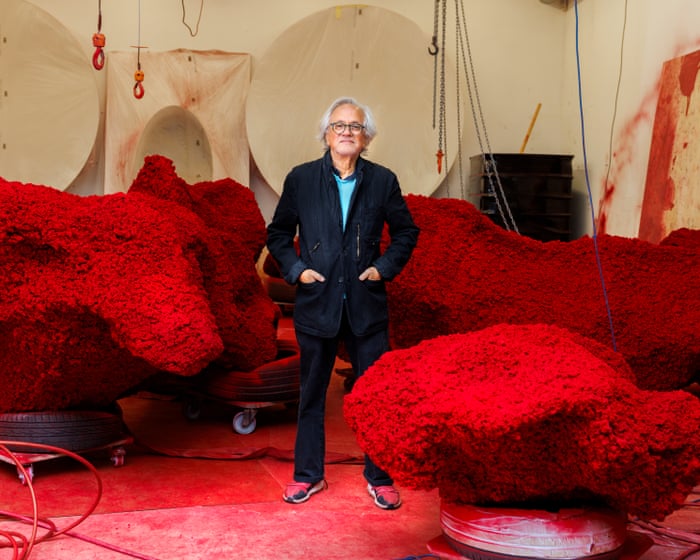
Anish Kapoor's 3,100-square-metre studio complex in south London houses a staff of 23 – 11 studio assistants, nine office workers, and three stone masons. Some have worked with him for decades. The studio occupies a converted dairy factory, with each room dedicated to different types of work: large red installations, small black sculptures, exhibition models, concave mirror paintings, and archival drawings.
On the windowsill sits a solid concrete cylinder excavated from the Hayward Gallery's floor – a gift from outgoing director Ralph Rugoff for Kapoor's 72nd birthday in March. It symbolises the 1.5-metre-wide hole drilled out for the upcoming show.
New Works
Kapoor shows off a giant red mountain-like structure with a signature void carved into it – one of 31 parts forming the new piece "Ha Makom". Next door is "Ancestor", a meteorite-like form worked on for four to six months. Hazmat-suited assistants apply a red-tinted mixture of sawdust and resin to its pock-marked surface.
The Hayward exhibition will feature iconic works: the red inflatable "All of Nothing" so large it cannot be seen fully, floor sculptures "Ritual Expiation" resembling blood and guts, and the perplexing black void of "Descent into Limbo".
Career Highs and Controversy
Kapoor rose to international fame after representing Britain at the 1990 Venice Biennale. He has won the Turner Prize (1991), the Wilhelm Lehmbruck Prize (2025), and many other honours. However, his work has also attracted criticism – the Orbit sculpture was called a "meaningless plutocrat's plaything".
Controversy also surrounds his exclusive license for Vantablack, the "blackest black" coating. Kapoor insists it is not paint.
Personal Story
Born in Mumbai to a Hindu father and an Iraqi-Jewish mother, Kapoor emigrated to Israel at 16 with his brother, where they faced racial slurs. He moved to the UK in 1973 for art studies. He is openly critical of politics, including the Israeli government and the UK's treatment of pro-Palestine protesters. He recently collaborated with Greenpeace, installing a blood-red canvas on a North Sea gas rig.
Creative Philosophy
Kapoor describes two sides to his practice: one that the market likes, and the other – monumental works he has never sold. He seeks the "ahhh" moment for viewers. He rejects interpreting art solely through personal biography, arguing that artists can inhabit other states of consciousness.


