Astronomers watch a giant star swallow its companion and explode
In the Andromeda Galaxy, astronomers spent nearly a decade observing a star about seven times the Sun's mass engulf a smaller companion. The process ended in an eruption in October 2025, the first time such an event has been observed.
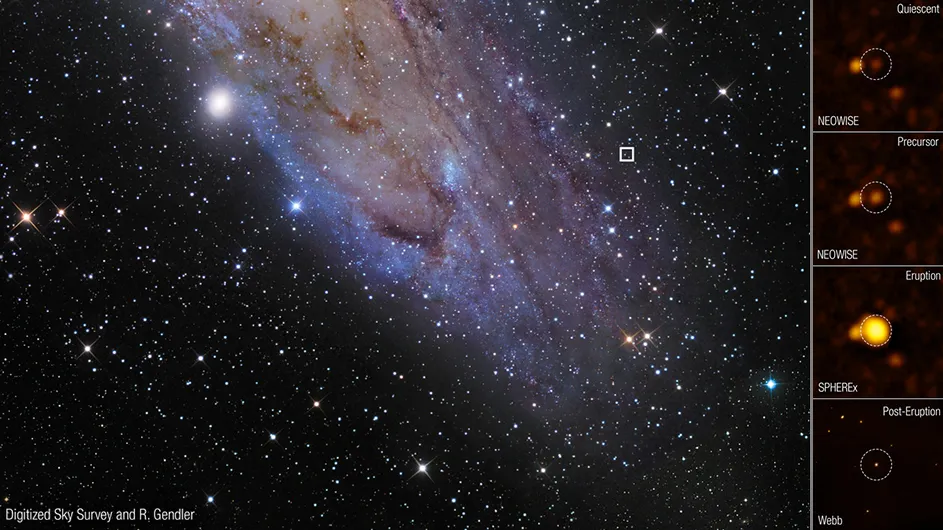
A team of astronomers led by Viraj Karambelkar, an astrophysicist at Columbia University, has observed something never caught before: a giant star in the Andromeda Galaxy slowly swallowing its much smaller companion over almost ten years, ending in a bright eruption in late 2025. The study was published in the journal Nature. The observation matters because it helps explain how some of the tightest pairs of stars in the Universe form.
The star, about seven times as massive as the Sun, has been designated AT 2025abao. The process is called common envelope evolution. It was proposed in the 1970s to explain how very close star pairs arise, but nobody had watched it happen.
How the process works
When one star in a binary grows old, it expands into a giant, and its outer layers can engulf its partner. The two then share a single envelope of gas. The engulfed star loses orbital energy to friction and spirals inward. Depending on how much of the envelope is lost, the pair either settles into a much tighter orbit or merges.
The researchers found the candidate while searching Andromeda for stars with changing brightness, using the WINTER infrared telescope at Palomar Observatory and data from NASA's NEOWISE mission. They reconstructed the system's history from about a dozen telescopes and surveys, going back to photographic plates from 1989. Until 2018 the star barely changed; it was an aging giant about 350 times wider than the Sun. Its companion could not be seen because the giant outshines it by a factor of about 18,000. From the dust the system had shed, the team estimated the companion's mass at roughly 0.7 solar masses.
Between 2018 and early 2025 the giant brightened two- to three-fold in visible light. In July 2025, NASA's SPHEREx space telescope found it had swollen to about 860 times the Sun's width. In October 2025 its brightness rose roughly 100-fold in 25 days, reaching about 1.5 million Suns.
What the explosion revealed
According to Karambelkar, the companion fell very quickly deep into the envelope and crashed into the core. The event had the hallmarks of a luminous red nova, an outburst from merging stars. Unlike previously known cases, this one involved an old star with a loose envelope. In the final plunge about a tenth of the envelope was flung outward. This suggests the companion merged with the core, though the team cannot be certain because dust hides the interior.
The researchers plan to keep monitoring the system for several years. The Vera Rubin Observatory and the Nancy Grace Roman Space Telescope should be able to detect several such events per year.