US Army detonates 4.4 tons of lead azide at Iowa ammunition plant
On Wednesday the US Army deliberately detonated 68 barrels of degraded lead azide in southeastern Iowa to prevent an uncontrolled explosion. Nearby residents were told to evacuate or shelter in place because of a possible toxic lead plume.
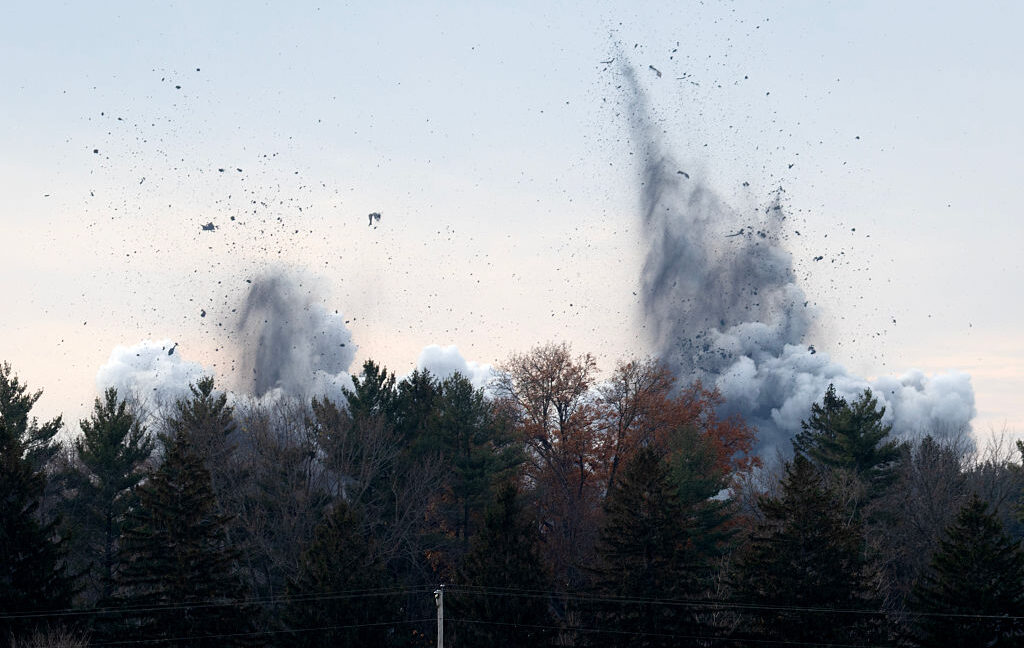
The US Army on Wednesday, at about 9 am Central Time, carried out a controlled detonation of 68 barrels holding 9,700 pounds (4.4 tons) of degraded lead azide. The blast took place at the Iowa Army Ammunition Plant in Middletown, a town of fewer than 400 people in southeastern Iowa. Lead azide is a crystallized, highly unstable compound, and the operation was meant to prevent it from exploding spontaneously and without control.
Residents within a 5-mile radius of the facility were advised to evacuate. People living farther away were told to stay indoors, close windows and doors tightly, switch off fans and set indoor air systems to recirculate.
The blast on live television
Local Iowa outlet KWQC captured the plume rising from the two earth-covered containers, which were detonated at the same time. A journalist for the station, reportedly standing at a safe distance, said during the live broadcast that he could see the shockwave and then feel it move across the crop field where he stood. He wore a mask for the remainder of the broadcast.
Lead risks and forecasts
Lead is a neurotoxin that does not break down in the environment and carries significant health risks, especially for young children and pregnant people. In the hours before the detonation, the Army published maps modeling how the plume would drift and spread. They showed airborne lead travelling about 100 miles southwest of the facility, with dust deposition covering roughly 200 square miles in the same direction.
Researchers and government workers have already gathered air and soil samples in the area. These will serve as baseline readings against which lead levels can be compared after the detonation and its fallout.