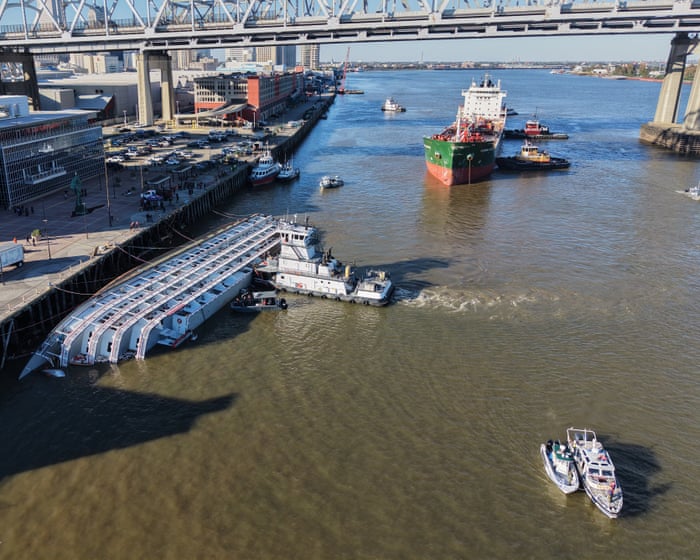
Steering failure preceded New Orleans cruise ship collision, US investigators say
The US National Transportation Safety Board (NTSB) said the cruise ship American Heritage suffered a steering problem before its collision on the Mississippi River in New Orleans. The exact cause of the fault has not yet been determined.
The National Transportation Safety Board (NTSB), the US agency that investigates transport accidents, said the cruise ship American Heritage had a steering failure before Friday's collision on the Mississippi River at New Orleans, Louisiana. About 129 passengers, along with crew, were aboard; the vessel began to list and tipped onto its side, and passengers were evacuated.
What investigators found
Based on the vessel's voyage data recorder, the NTSB said the tanker was travelling upriver and moving toward the river's east bank just before the impact. Minutes earlier, the recording captured audio consistent with the ship's warning system, along with commands to drop the anchors and emergency ship-handling orders.
Investigator-in-charge Bart Barnum told a news conference that investigators know of a steering problem that left the rudder in a starboard position, causing the vessel's heading to veer toward the east bank. The exact fault has yet to be determined. The NTSB expects to issue a preliminary report within 30 days.
The rescue
Calls about the collision began around 13:30 Eastern time (18:30 GMT), as people tried to help passengers get off the boat while it took on water, said Port of New Orleans chief Melanie Montroll. Tugboat operators, police and other rescuers helped, and officials shut down river traffic on the Mississippi during the operation.
The American Heritage is a paddlewheel vessel operated by American Cruise Lines. It was finishing an eight-day cruise to destinations in Louisiana and Mississippi along the waterway.