US politicians from both parties criticize Trump's provisional deal with Iran
US political figures from left and right voiced fresh objections on Sunday to Donald Trump's provisional deal with Iran, even as Vice-President JD Vance hailed progress during the first round of direct peace talks in Switzerland.
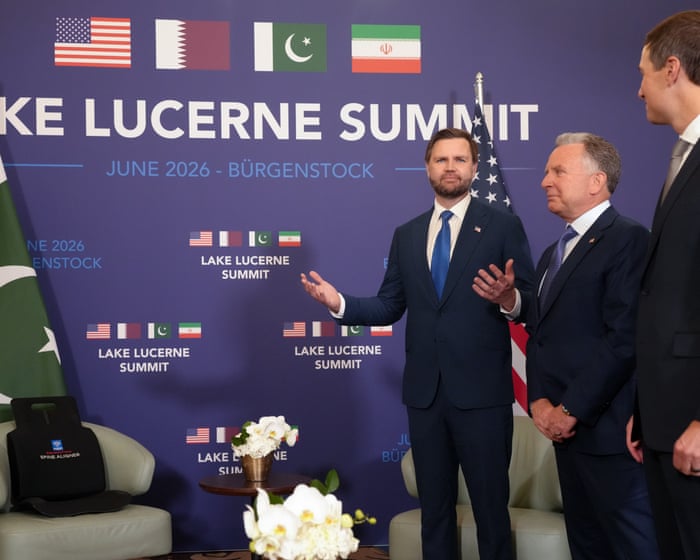
US political figures from left and right voiced fresh objections on Sunday to Donald Trump's provisional deal with Iran – even as the US president made fresh threats while Vice-President JD Vance hailed progress during the first round of direct peace talks in Switzerland.
Senator John Cornyn, a Texas Republican who recently lost his primary battle for re-election, posted a line from a Wall Street Journal article on how rogue regimes evade US economic warfare. It said: “Iran’s ability to withstand sanctions so far exposes a hard fact for Washington: economic pressure has largely failed to cow rogue regimes, as they game out more ways to sidestep US restrictions.”
This amplified remarks from two days ago where he said he had hoped that before striking a deal that involved releasing restricted Iranian funds the US would have “finished the job” and eliminated Iran’s hostile nuclear capability, warning that “now they will use that money … to replace their ballistic missile assets and begin to enrich [uranium] again and that’s going to be a continuing danger.”
On Sunday morning senior Democratic figure Susan Rice, a domestic policy aide to Joe Biden and former US ambassador to the United Nations and national security adviser under Barack Obama, added to her recent description of the memorandum of understanding (MOU) between the US and Iran as a “jaw dropping, horrific surrender” by Trump, by calling it “flimsy” and “egregious” because “so many concessions were granted up front”.
Rice told ABC News This Week that the concessions to Iran in the MOU, signed by Trump in Paris last Wednesday, “wouldn’t normally be, and shouldn’t have been, granted until after there was not only a fully comprehensive deal to, at least, deal with their nuclear program, but also that those provisions that were negotiated had been agreed”.
Rice pointed to a provision in the document that, chiming with Cornyn’s remarks, showed Iran “is now able to sell all of its oil and all of its oil products on the market unimpeded, and use that money to rebuild itself” ahead of any agreement on the nuclear issue.
The bipartisan criticism came as Trump threatened to renew military attacks on Iran if it didn’t cooperate and rein in its proxy in Lebanon, Hezbollah, including a forcible takeover by the US of control of the strait of Hormuz shipping channel.
Senator Cory Booker, a Democrat from New Jersey, rejected an invitation to offer Trump credit for ending the war. “That’s like literally an arsonist starting a fire and getting credit for running out of the burning building. This president has led this nation into a disaster. We have surrendered our power,” Booker told NBC’s Meet the Press. “We have capitulated to the enemy. And they now are mocking us.”
Booker said that under the memorandum of understanding “Iran gets all of the benefits, literally billions and billions of dollars” and called it “an abject surrender”.
As the first round of face-to-face US-Iran talks in Lake Lucerne in Switzerland wrapped up late on Sunday morning, Vance said that negotiators had “already made great progress over just the last few hours, and I expect that we’ll make additional progress in the hours to come.”
Last week Ted Cruz, the Republican senator of Texas, said Trump was getting bad advice on Iran. “History demonstrates that giving billions of dollars to theocratic lunatics who want to murder us is an exceptionally bad idea,” he said.
Meanwhile the US energy secretary, Chris Wright, said on ABC’s This Week on Sunday that the Lucerne talks would “set out what the Iranian goals are and what they think the tradeoffs they might have to make are.” He added: “We’ve just never been in this situation before. The US military, both in the actions to destroy the Iranian military capabilities and to force a way through the strait of Hormuz, without any dialogue, have just put the Iranians in a massively different situation. They don’t have the leverage they’ve always had in talks before.” Wright declined to predict when US consumers would see a return to pre-war gas prices, but said flows of oil and natural gas through the strait have already returned to normal.