Trump threatens tariffs on Canada over wildfire smoke choking US cities
US President Donald Trump has threatened to impose new tariffs on Canada as hundreds of wildfires blanket northern US states with hazardous smoke, sparking a diplomatic row.
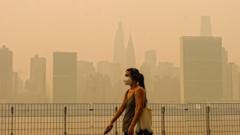
US President Donald Trump has threatened to impose new tariffs on Canada, accusing the country of "willful negligence" after hundreds of wildfires sent thick smoke across the northern United States. In a Truth Social post, Trump said the US is being "unnecessarily invaded by filthy, polluted, and unhealthy air" and that he would call Canadian Prime Minister Mark Carney to demand an explanation over Canada's forest management.
As of Friday, approximately 888 wildfires were actively burning in Canada, with the majority out of control, according to the Canadian Wildland Fire Information System. More than 190 of those fires were in Ontario, many also out of control. US lawmakers John James, John Moolenaar, Jack Bergman, and Lisa McClain wrote an open letter to Canadian officials stating their "patience has run out." They warned that "American lungs are paying the price for Canadian inaction, year after year" and hinted that the US could directly engage in cross-border firefighting if Canada fails to act.
Ontario Premier Doug Ford responded by reminding that Canada has helped the US battle wildfires in California and respond to hurricanes in North Carolina. "Maybe what you should do rather than complain is send support, send help, because we have done the exact same thing for our American friends," Ford said. Carney told reporters that "climate change is everyone's responsibility — truly everyone's — including the United States."
Scientists interviewed by the BBC emphasized the complexity of the issue. "Weather doesn't care about international borders," said Dr. Patrick James from the University of Toronto, noting that smoke from major US wildfires has also affected Canada in recent years. Experts added that many fires burn in vast, remote forests where they are difficult to detect and contain. They also pointed to climate change as a driver of more severe wildfire seasons, creating hotter and drier conditions.
The smoke has triggered "hazardous" air quality alerts across multiple US states, including Minnesota, Michigan, Pennsylvania, Ohio, and New York. Detroit had the worst air quality in the world on Friday, followed by Chicago and Washington DC. New York ranked seventh. The haze obscured landmarks such as the Empire State Building and the Statue of Liberty. Outdoor events, summertime camps, and concerts have been canceled or moved indoors. One beach along a popular lake was closed.
Fires in northern Ontario forced evacuations of at least 10 communities. Chief Helen Paavola of the Namaygoosisagagun First Nation said an aerial survey showed her community has been "burnt to ashes." Ford stated it's a miracle no lives were lost. Ontario has deployed over 150 fire crews, 80 water bombers, and helicopters, and has spent over a billion dollars on wildland fire since 2018. Ford assured that they are "throwing every single resource we can."
White House officials, including Andrew Giuliani, head of the White House World Cup task force, are informally consulting with FIFA about potential impacts on Sunday's World Cup final between Argentina and Spain at MetLife Stadium in New Jersey, an open-air venue. Trump is expected to attend. Forecasters predict rain over the weekend will improve conditions before the match.

