Fruit flies use memory, not just reflexes, to track scent plumes
Scientists have found that fruit flies rely on short-term memories of odor plume edges rather than only reflexive responses to locate food. The discovery challenges the classic surge-and-cast model and shows how a tiny brain can store spatial goals.
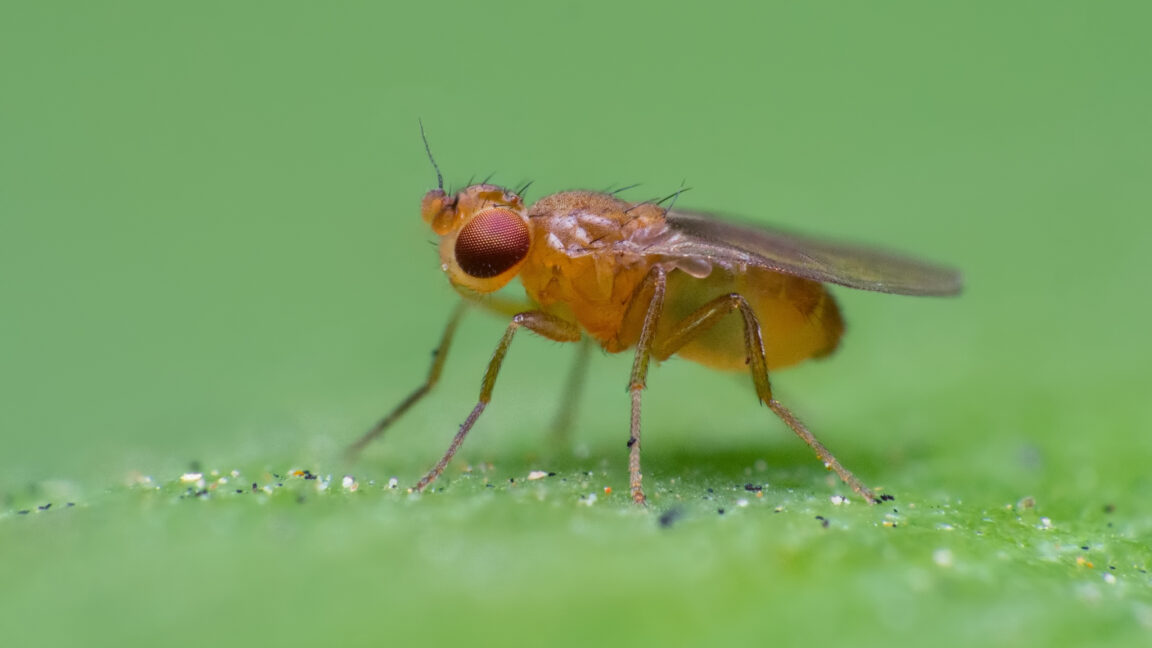
Fruit flies locate food and mates by following odor plumes, but in nature turbulent air breaks these plumes into scattered filaments. Until now, researchers assumed insects relied on simple reflexes called surge-and-cast: fly upwind when detecting a scent, then cast side to side once the scent is lost. A new study from Rockefeller University shows that Drosophila actually employ a more sophisticated strategy involving stored memory.
The team, led by neuroscientist Vanessa Ruta, built a virtual reality treadmill. A fly was tethered over an air-cushioned ball in darkness, and its movements controlled a nozzle that delivered an airstream with or without apple cider vinegar. This setup allowed precise control of the odor landscape the insect experienced. In experiments with a straight 50-millimeter odor corridor, flies did not follow the model's predictions. Instead, they repeatedly crossed into the scent, turned back, looped through clean air, and returned to the boundary. The researchers called this behavior edge tracking. Flies spent most of their time outside the plume, yet their progress toward the source occurred during brief dips into the odor.
Even when the odor gradient was reversed, the flies tracked the edge just as well. Genetically modified flies whose olfactory neurons could be activated with 660-nanometer red light also tracked the edge of a light plume perfectly. The real insight came when the plume disappeared: flies continued heading toward where the edge had been, indicating they had stored a memory of its location.
Using neural imaging, the team identified a compass system in the central complex and a goal-directing network in the fan-shaped body. When either was silenced, the flies became disoriented. A computer model showed that the most crucial piece of information for edge tracking is the entry angle—the direction from which the fly last encountered the plume. In a follow-up experiment with a plume flipped 45 degrees, a single corrective puff of vinegar was enough for flies to update their memory and adjust their navigation.
The findings do not completely discard older models. Simulations suggest that memory is most reliable near the source, where the plume is a coherent ribbon; downwind, where it becomes chaotic, simpler reflexes may take over. The authors say this work demonstrates how even a tiny brain can translate fleeting sensory signals into spatial memories—a fundamental process likely shared across the animal kingdom.
The study was published in Nature with the DOI 10.1038/s41586-026-10827-7.