Brandenburg farm tests 60 cm deep ploughing to build up soil humus
An agricultural cooperative in Brandenburg, eastern Germany, is testing partial deep ploughing to raise soil humus stocks, an approach first used in East Germany. In the dry spring of 2025, green rye yields on the deep-ploughed area were 44% higher than on the cultivated plot.

Agrargenossenschaft Groß Machnow, an agricultural cooperative south of Berlin in the German state of Brandenburg, is testing partial deepening of the topsoil layer. The aim is to increase the soil's stock of organic carbon, known as humus. The trial is supported by HumusKlimaNetz, a network focused on humus building and climate protection. Early results show that in the dry spring of 2025, green rye on the deep-ploughed part of the field out-yielded the comparison plots.
How the deep plough works
The method is best known through the so-called Carbon Farming plough, a prototype developed by the Leibniz Centre for Agricultural Landscape Research (ZALF) together with the company Lemken. This special deep plough breaks up the plough pan and mixes the topsoil into deeper soil layers.
Farm manager Lilian Guzmán Pfeiffer explains that every second share lifts out a shaft about 50 to 60 cm deep, which is filled with humus-rich topsoil. In exchange, humus-poor soil is brought to the surface.
An approach from East Germany
The approach originates in the German Democratic Republic (East Germany), where it was used in the 1970s and 1980s. To this day, the area ploughed deeply back then contains markedly higher levels of nutrients and organic carbon than the rest of the subsoil. The humus loss in the topsoil caused by mixing in subsoil was made up within about ten years. Partially deep-ploughed soils can therefore serve as long-term carbon, humus and nutrient stores.
ZALF researchers Jürgen Augustin, Michael Sommer and Marisa Gerriets confirmed the climate benefit in field trials under the projects "Krumensenke" and "CarbonTillage".
Results at Groß Machnow
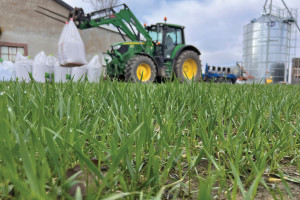
In 2024 the deep plough was used on one field, with a second part ploughed conventionally and a third only cultivated with a tine cultivator. Green rye was sown. The following year the yield on the deep-ploughed variant was 9% higher than on the conventionally ploughed area and 44% higher than on the cultivated one.
Guzmán assumes that in the dry spring of 2025 the plants there could draw nutrients and water from the subsoil more effectively. For the maize sown afterwards, no yield differences remained: its roots were presumably too small at first to reach the subsoil, and later conditions were good enough for the crop to thrive on all three parts.