Defcon's new badge hides an open-source security chip inside
This year's Defcon badges, created by hardware hacker Andrew "bunnie" Huang, feature a transparent, removable open-source chip that can be used as a security key after the conference.
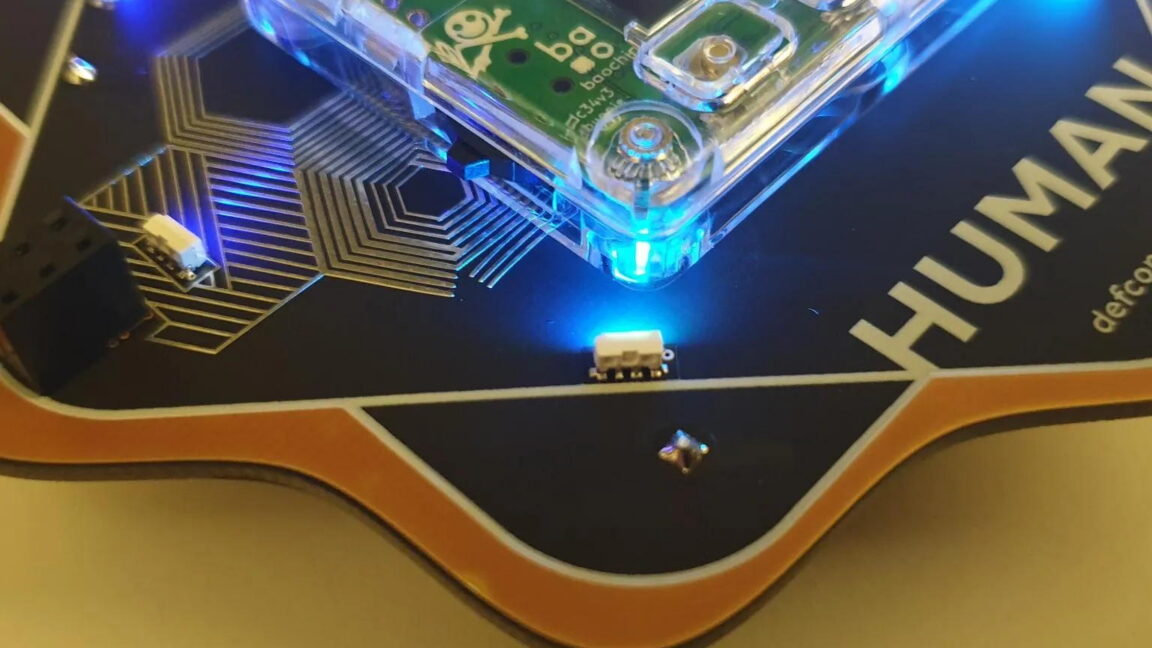
For years, attendees of the annual Defcon hacker conference have walked away with more than just new knowledge of security vulnerabilities; they also receive elaborately designed electronic badges, often featuring puzzles, cryptographic challenges, and even mechanical watch parts. This year, the focus has shifted from the badge design itself to the hardware inside.
Organizers asked veteran hardware hacker Andrew "bunnie" Huang to create the badges. The centerpiece is a new open-source chip called Baochip-1x, designed to advance security, transparency, and trust in computing. The chip's core module is removable, allowing it to serve as a hardware security token after the conference ends.
Huang has published the chip's operating system, firmware, processor core, cryptographic engines, and I/O system source code on GitHub. The chip is also packaged so that infrared light can pass through the back of the silicon, letting researchers visually inspect the internal structures and compare them with the published design. This addresses a common supply-chain problem with conventional opaque chips, where users must trust that nothing was altered during manufacturing.
Huang's involvement began three years ago when Crossbar, a company looking to create an open-source secure chip, contacted him. He agreed to help on the condition that he could piggyback his CPU on their manufacturing wafer. The resulting wafer carries both Crossbar's microprocessor and Huang's RISC-V core. In the Baochip version, the proprietary ARM core is disabled, leaving the open-source RISC-V implementation active. Some low-level manufacturing details, including TSMC's 22nm process, remain proprietary.
The badge concept came together after Huang met Defcon founder Jeff Moss late last year. Moss wanted the badges to have a life beyond the conference, not ending up in a drawer or landfill. The removable module works as a FIDO security token, supports time-based one-time passwords and password management, and includes a low-resolution, nearsighted camera for scanning QR codes. By default, the camera only captures black-and-white data and cannot store photos.
Security features include an operating system written in Rust, secure boot, a true random number generator, and hardware hardening. The chip uses resistive RAM (RRAM), which Huang says is harder to extract than conventional flash memory. Huang is cautious about overhyping security, estimating that an adversary with millions of dollars and a sophisticated lab could likely break it. He expects Defcon attendees to stress-test the chip and find zero-days, which he considers a feature of launching at the conference.
The badge also includes LEDs that flash in different color palettes and patterns depending on the badge type, and users can build more complex patterns when badges communicate. The 27,000 Defcon badges represent the first major distribution of the Baochip. The hardware runs a 350 MHz RISC-V processor, 2 MB of SRAM, and 4 MB of RRAM, along with four 700 MHz PicoRV32 cores for I/O. Huang plans to expand the chip's features and expects participants to make the chips their own.