Former Russian Official Elected President of Breakaway South Ossetia
Marat Kambolov, a former Russian federal official with no prior ties to South Ossetia, has been elected president of the Georgian breakaway region, a result Moscow hailed as proof of the territory's desire for closer ties with Russia.
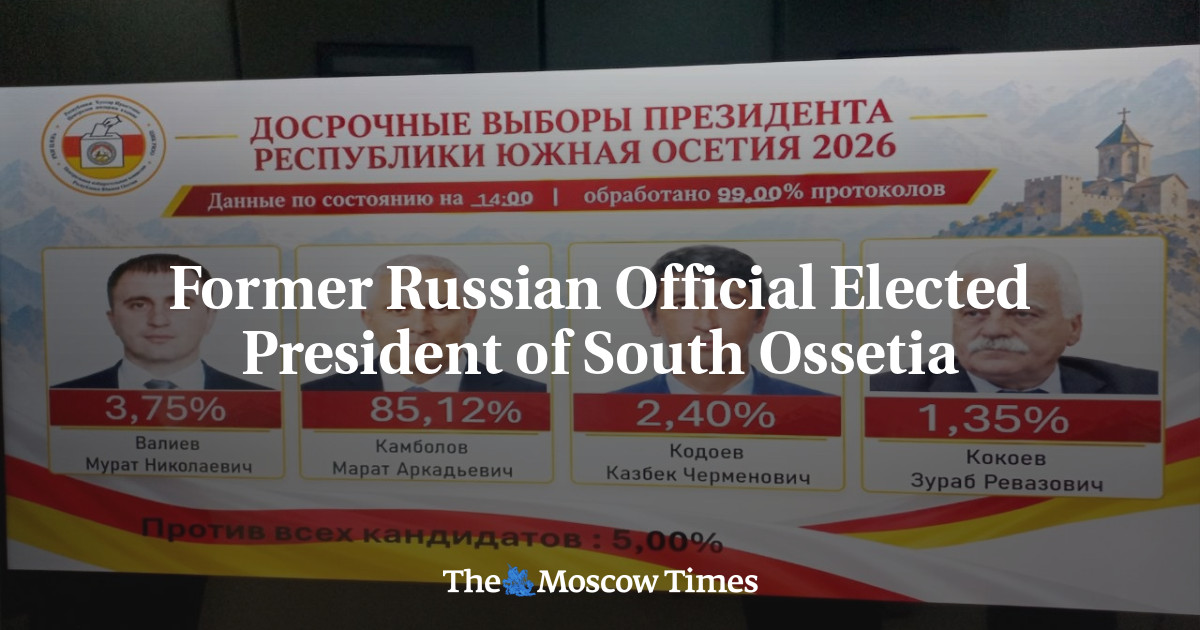
South Ossetia, the Russia-backed breakaway region of Georgia, elected Marat Kambolov as its new president on Friday. Kambolov, 61, previously held senior posts in Russian federal government, including at the Education Ministry, and hails from North Ossetia, a Russian republic on the other side of the Caucasus Mountains — he had no earlier connection to South Ossetia itself.
Russia's Foreign Ministry said on Saturday that the vote reflected broad public support in South Ossetia for domestic stability and deeper integration with Russia. Kambolov was appointed the territory's prime minister in June, after Alan Gagloyev stepped down as president to take up an advisory role to Russian President Vladimir Putin. Putin sent a congratulatory telegram to Kambolov, published on the Kremlin's website.
Speaking after his win in the South Ossetian capital, Tskhinvali, Kambolov promised to raise living standards, telling supporters: "We have a great deal of work ahead of us. Only together can we change our republic, our Tskhinvali." Russian state media reported Kambolov took 85% of the vote, with rival candidates polling in the single digits and turnout reaching 73%.
South Ossetia split from Georgia amid the Soviet collapse in the early 1990s and later achieved de facto independence with Russian military and political backing. A short war between Russia and Georgia in 2008 pushed Georgian forces out of territory they had held. In May, South Ossetia and Russia signed a treaty deepening cooperation on defense, foreign and security policy, and outlining plans to integrate energy grids and transportation networks. Georgia denounced the agreement as a step toward cementing Russia's de facto annexation of both South Ossetia and Abkhazia, another breakaway region, and also criticized Moscow's decision to open polling stations in the two territories for Russia's State Duma elections held Sept. 18-20.
With a population of roughly 50,000 and little industry of its own, South Ossetia relies heavily on Russia for food, equipment and energy. Moscow funds public-sector wages, pensions and major infrastructure projects in the territory and maintains a military base there.