Europe's Hera Probe Finds Chaotic Scene After Asteroid Deflection Experiment
The European Space Agency's Hera spacecraft has reached the Didymos and Dimorphos double asteroid, where NASA's DART probe carried out a deflection test in 2022. First images show a stadium-sized crater, a wildly tumbling Dimorphos and hundreds of boulders around the pair.
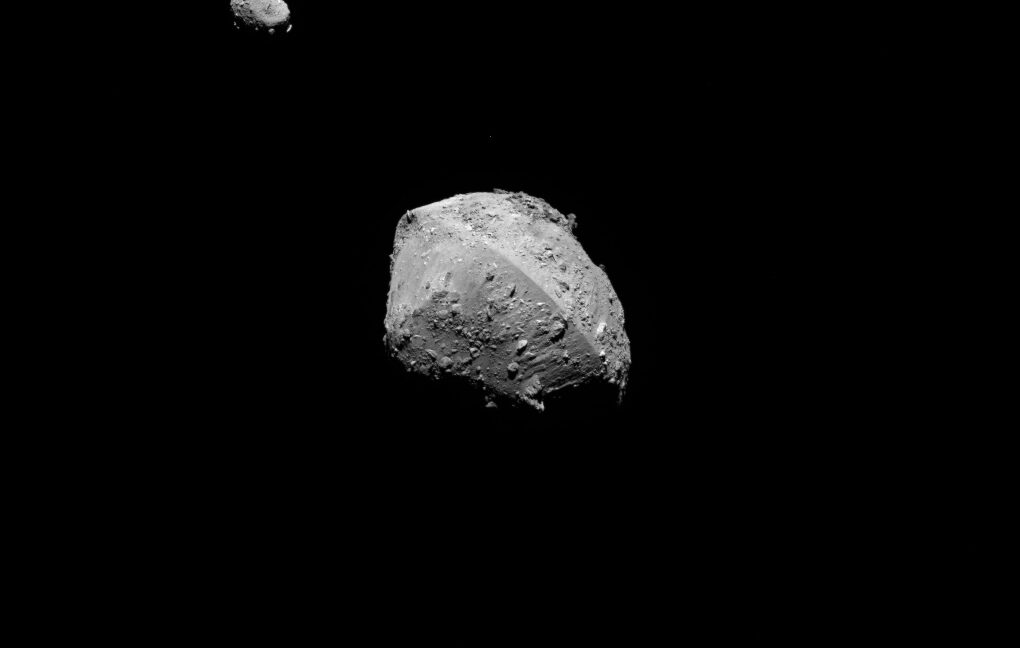
The European Space Agency's (ESA) Hera spacecraft, which arrived at the Didymos and Dimorphos double asteroid system after a two-year journey from a Florida launch pad, has captured the first close-up views of the site where NASA's DART probe struck in September 2022. That test was the first attempt to show how humanity could redirect an asteroid threatening Earth, and Hera's data should help refine how it might be done in future.
The experiment four years ago
DART hit the smaller asteroid, Dimorphos, at about 6.14 kilometers per second, releasing roughly 10 billion joules of energy. The impact shortened Dimorphos's 12-hour orbit around the larger Didymos by about 33 minutes, 25 times the most conservative expectation. The spacecraft was destroyed in the collision, so scientists could judge the aftermath only from distant telescopes and a small CubeSat.
What Hera found
On Wednesday ESA released the first images of the scar left by DART. The car-sized impactor carved a stadium-sized crater, nearly as large as Dimorphos itself, which measures about 151 meters across. Patrick Michel, Hera's principal investigator at Côte d'Azur Observatory in Nice, France, said the asteroid's shape has changed and scientists are still unsure how that happened. ESA Hera mission scientist Michael Kueppers said Dimorphos is now tumbling wildly in its orbit, while Didymos spins as it did in 2022.
During its initial reconnaissance, Hera also spotted hundreds of boulders around the asteroids, ranging in size from a football to a washing machine. One explanation is that they were thrown off Dimorphos by the impact, but scientists say they need more information. The debris might also be relics from the formation of Dimorphos.
Next steps
Over the next six months Hera will fly closer to the asteroids and release two small sub-satellites to attempt landings on Dimorphos, gathering data on its composition, internal structure and mass. Scientists will use the results to reconstruct the impact and improve models for deflecting different types of asteroids.