Over 250,000 evacuated as wildfires sweep France and Spain
Uncontrolled wildfires in Spain and France have forced more than 250,000 people to flee. Spain has declared a national emergency for the first time due to a wildfire, while France's evacuation is likely the largest peacetime evacuation in its history.
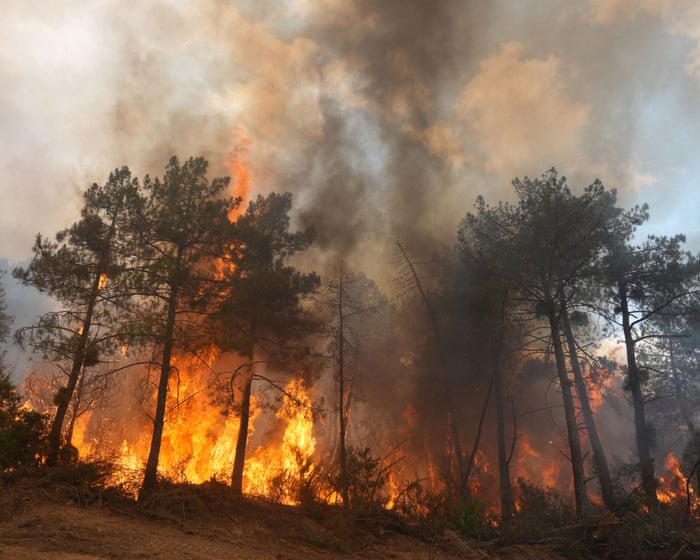
Uncontrolled wildfires in Spain and France have forced more than 250,000 people to flee, authorities from both countries have said. Approximately 70,000 people were evacuated from central Spain, while 197,000 fled in France, including tens of thousands from the wine region city of Bordeaux.
Spain declared a national emergency for the first time over a wildfire. France's interior minister said the evacuations constituted “probably” the biggest peacetime evacuation the country has ever seen. Hundreds of firefighters are working to contain the blazes, fueled by persistent heatwaves and the climate crisis, but have been unable to stop their advance. In Spain, high winds are exacerbating the fires, and two of the three blazes merged on Friday.
France's interior minister, Laurent Nuñez, said a huge military cargo plane, the Airbus A400M Atlas, was being deployed to join 18 other aircraft in the “long and very difficult” battle against wildfires in the Gironde region of southwestern France. The French government has called in the military, deploying 1,500 soldiers, and has rushed 1.5 million face masks to protect people from smoke inhalation. Fire crews have been digging trenches and using retardants, as winds were forecast to push the fires closer to Bordeaux. Wildfires were reported to be about 20 miles west of the city.
The French government ordered people in the path of the fire to evacuate, including those in Bordeaux's western suburbs. Police went door to door to tell people to leave, with scenes of panic unfolding as residents fled under a smoke-darkened sky. The Gironde regional prefect, Sophie Brocas, said on Friday that strong winds were driving the fire towards the Bordeaux metro area and that it had grown to “an unprecedented magnitude.”
Officials said the sudden blazes caught residents and authorities off guard. Some people in France had to flee by boat when the flames headed towards coastal towns. The French prime minister, Sébastien Lecornu, said the fire in Gironde was so strong that it had begun generating its own winds. “The fires that are hitting our country have reached a level that has never been seen before,” he wrote on X. “Our priority is clear: protecting human lives.”
The Spanish health minister instructed people in Madrid not to go outside due to poor air quality and advised wearing masks if outdoors with smoke or ash. On Saturday evening, Spain's interior ministry said a man had died in a fire in Manises, in Valencia. He was found in a car in a ravine. That fire was separate from the major blazes west of Madrid, which have so far not caused any reported deaths.
The long, back-to-back heatwaves in Europe have dried forests, turning them into tinder for wildfires. Spain's prime minister, Pedro Sánchez, said on Saturday that fires had already consumed 130,000 hectares (320,000 acres) of forest this year in Spain, about a third higher than the country's annual average. In France, fires burned down more than 98,000 hectares, which the interior minister called a “historic record.”
Scientists say climate breakdown is triggering more frequent and extreme weather events, evaporating soils and waterways, fueling wildfires, and leading to thousands of excess deaths. Europe is heating at about twice the global average rate.
Sánchez said that cooler weather on Saturday gave a “window of opportunity” for firefighters to contain the blazes. “We are going to have some complex hours ahead because, although the temperatures have gone down, we do not know exactly how the wind will develop, how strong it will be,” he added.
Other European countries are helping both countries fight the blazes, with Croatia, the Czech Republic, Greece, Italy, the Netherlands, Portugal, and Slovakia sending aid and water-dumping aircraft to France and Spain. The European Commission president, Ursula von der Leyen, promised more help was on the way.

/nginx/o/2026/10/01/17950061t1h2584.jpg)
/nginx/o/2026/10/01/17950045t1hb53a.jpg)