Anguished families left to identify Venezuela quake victims at makeshift morgue
In Venezuela, after two powerful earthquakes killed more than 2,600 people, families endure long waits to identify their loved ones at a makeshift morgue set up in a port storage facility in La Guaira.
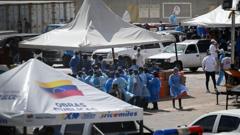
At a port storage facility transformed into a makeshift morgue in La Guaira, the same scene repeats itself again and again. Families—many of whom have already spent days searching hospitals, shelters and rubble—wait hours to try and confirm the deaths of their loved ones.
As the death toll of Venezuela's twin earthquakes surpasses 2,600, officials face the challenge of not only recovering victims, but identifying them. The scale of the disaster has overwhelmed local services, forcing institutions to improvise.
With little infrastructure left standing nine days after the tremors, bodies have been put outside or in temporary tents. Under the blazing sun, decomposition is rapid.
"I'm afraid of what I'm going to see in there, but it's the only way to end this agony," a woman says before passing through the gate. She has been searching for her nephew for nearly a week.
Inside, the smell of decomposition is the first thing that greets you. Hundreds of bodies lie in rows, wrapped in plastic bags and exposed to the sun.
Families face two options. Those who think they can identify a loved one by their clothing are taken to one area. Most relatives, however, are directed to two television screens where more than 1,000 images of bodies flash across the screens.
Liliana González, a 60-year-old resident of Catia La Mar, identified her 37-year-old nephew by his tattoo. "He wasn't on the list," she says. "I had to look at the images."
Modesta Alemán, 56, travelled from Carayaca to look for her older sister Matilde. Volunteers later said they could hear voices calling from the building, "but no one could get them out".
Jéssica Soto, 42, has been waiting for two days for the remains of her 15-year-old daughter and three-year-old granddaughter. Their bodies were recovered on Tuesday, nearly a week later. "They keep you waiting and waiting for the paperwork, the trucks, and who knows what else," she says. "I have no choice but to wait and trust in God."
Liliana says she panicked when told she would have to identify her nephew by herself, but two workers accompanied her. Her aunt remains buried in the rubble, and she fears having to return to the morgue in the coming days to repeat the process.

