Hull Maritime Museum reopens with a walk-in whale skeleton and quirky treasures
Hull Maritime Museum has reopened after a £20.4m renovation, headlined by a 40ft North Atlantic right whale skeleton. The museum now has twice the public space and displays around 1,300 objects.
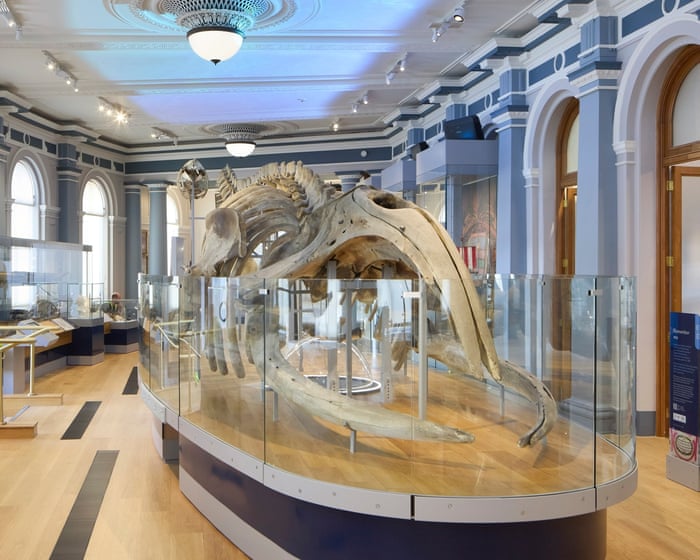
After a £20.4m renovation, Hull Maritime Museum has reopened, with a giant North Atlantic right whale skeleton as its showpiece. The 40ft remains, from a whale beached more than a century ago, fill a space barely big enough for them. Visitors can crawl into the ribcage and watch digital images of swimming whales projected on the ceiling. The species was hunted almost to extinction; fewer than 400 are thought to remain today.
Other highlights include a world-class scrimshaw collection, with a tiny carved whale that served as a toothpick and narwhal tusks turned into hatstands. Hull's maritime identity is tied to its location at the confluence of the River Hull and the Humber estuary, and its history of trade, whaling and fishing. Today the city produces wind turbine blades for offshore arrays and remains one of the UK's busiest port complexes, though its centre still has vacant shops and docks that were badly damaged during the Second World War.
The museum's building originally opened in 1871 as dock offices, designed by Christopher Wray, and became the city's maritime museum in 1975. Before the renovation, only two of four floors were open to the public, and a large ramp in the middle disrupted the gallery. The ramp has been removed and the colour scheme has been made more historically sensitive. Funding came from Hull City Council (£11.8m), the National Lottery Heritage Fund (£7.7m) and private donations.
Public space has doubled, and about 1,300 objects are now on display, including a stuffed polar bear, Inuit bootees and a so-called “monkey mermaid” – a chimera of a monkey fused with a fish. Exhibits trace migration, the shift from sail to steam, and the work of Lillian Bilocca, a “headscarf revolutionary” who campaigned for fishing safety in the 1960s. More than 6,000 crewmen were lost in 150 years of commercial trawling from Hull, and they are commemorated in the museum's memorial space.
The restored Court Room, with its heraldic shields of Hanseatic League ports and ornate ceiling, required eight conservators working for six weeks to hand-clean the plaster. It will now serve as an events venue. The museum is part of a wider regeneration effort, including the re-landscaped Queen's Gardens and a new visitor centre for the historic trawler Arctic Corsair. The project uses Hull's unsentimental maritime history to point toward a different kind of civic future.