EDF intel chief: Russia answers Estonia's border closure with more threats
Col. Ants Kiviselg, head of the Estonian Defense Forces Intelligence Center, says Russia is continuing information warfare and pressure on Europe. Moscow reacted sharply to Estonia's decision to close five border crossing points.
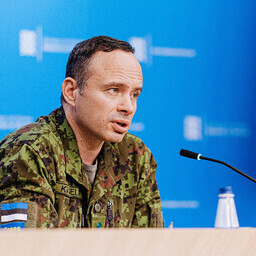
Col. Ants Kiviselg, who heads the Estonian Defense Forces (EDF) Intelligence Center, said in a weekly assessment that Russia is continuing its information warfare and pressure on European countries, while Ukrainian forces have mounted successful counterattacks and Russian losses remain very high. The assessment matters because it shows how Moscow is trying to shape both the war in Ukraine and European security decisions, including Estonia's.
According to Kiviselg, Russia is trying to present the war as a success internationally, including at the Asia-Pacific Economic Cooperation (APEC) forum, and is pressing Ukraine and Europe to accept the so-called reality. Moscow believes the European Union is evolving into a military and political bloc that poses a major threat to Russia. Ukraine's right to security is acknowledged in rhetoric, but deploying European troops there is considered unacceptable even after a possible peace deal.
The pressure also reached Estonia. The government decided to close five border crossing points in response to a Russian-ordered terrorist attack on the defense industry company Threod Systems. Moscow reacted sharply, accusing Estonia of anti-Russian activity and claiming the steps were on the verge of starting an open war with Russia.
Heavy fighting in Ukraine
There were nearly 190 combat engagements per day on average along the front. The most intense fighting was in the Pokrovsk and Kostiantynivka sectors of Donetsk Oblast, followed by Huliaipole and Lyman. In the Velykyi Burluk sector of Kharkiv Oblast, Ukrainian forces liberated several settlements and thwarted Russian attempts to cut off the region's northeastern corner, Kiviselg said. Ukraine's goal is to prevent a buffer zone from being established on its territory.
Russian forces suffered an average of 2,100 casualties per day last week. If the rate continues, monthly losses could exceed 65,000. Kiviselg also cited an independent estimate that as of September this year more than 700,000 Russian troops had been killed, out of 1.53 million total casualties.
Strikes reach Poland
Russia kept bombing civilian and energy infrastructure; five bridges in Kyiv have been damaged since early October. On November 20, three Russian Kh-101 cruise missiles entered Polish airspace and crashed on Polish territory. Kiviselg said Polish Prime Minister Donald Tusk did not believe it was a coincidence, since the coalition of the willing was holding its joint exercise Koalicja 26.2 in Poland at the time. NATO Secretary General Mark Rutte called the incident unacceptable, and NATO's Supreme Allied Commander Europe, Gen. Alexus Grynkewich, ordered an AWACS airborne warning aircraft deployed to Poland.
Ukraine responded with deep strikes behind Russian lines. Sixteen Russian oil refineries have been targeted in November, including in Rostov and Samara oblasts and Perm Krai. Kiviselg said this has cut Russian refining capacity by 40–50 percent, possibly to its lowest level in 20 years. Ukrainian drones also hit the Savasleyka military airfield and a space-based intelligence facility in Smolensk Oblast, and continued attacking the Kerch Bridge, where only one railway track remains operational.