Italian artist installs wolf sculpture on Vilnius' historic hill
A life-size bronze wolf by Italian artist Davide Rivalta has been placed on Gediminas Hill in Vilnius, symbolically linking Lithuania's capital founding myths with Rome.
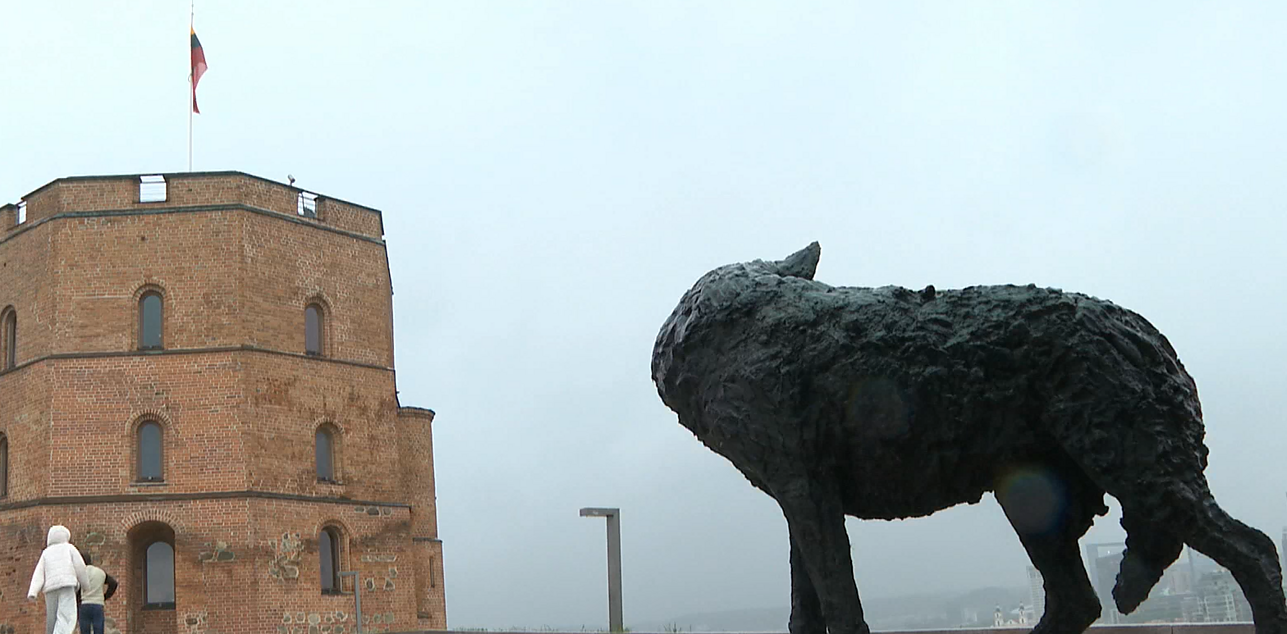
A life-size bronze wolf sculpture by Italian artist Davide Rivalta has been unveiled atop Gediminas Hill in Vilnius, creating a symbolic connection between the founding myths of Lithuania’s capital and Rome. The sculpture draws inspiration from the legendary Iron Wolf that appeared in a dream to Grand Duke Gediminas and inspired the founding of the city. It also echoes the ancient Roman legend of the she-wolf that nurtured Romulus and Remus, the mythical founders of Rome.
Rivalta, whose work often focuses on animals placed in carefully selected landscapes, said the wolf was a natural choice for the Vilnius commission. "In this particular case, the animal is a wolf because the work is directly connected to the legend of the Iron Wolf," the artist said. "The material is also important. The sculpture is made of bronze, a metal with its own energy, strength and inner power, which perfectly reflects the idea behind the work."
The artist noted that the location played a crucial role in the project’s conception. "From this hill, you can see the entire panorama of Vilnius – both the urban landscape and nature merging into the city," he said. "This place represents a boundary between wilderness and civilization."
Created specifically for Vilnius, the life-size sculpture is intended to highlight how cities are shaped by stories, symbols and collective memory while adding a contemporary element to the historic setting. Rivalta said his animal sculptures are based on years of observation and close study. For the wolf, the work was influenced not only by wolves he had seen in zoos but also by his own Czechoslovakian wolfdog.
Since 2017, Rivalta has installed large-scale animal sculptures, including lions, buffalo and orangutans, in public spaces across Europe. His works are currently exhibited in Italy, Ireland, Sweden, Norway and France.
According to Milda Gembickienė of the Lithuanian National Museum, the sculpture was donated by the Italian Embassy as part of commemorations marking the anniversary of the restoration of diplomatic relations between Lithuania and Italy. "It is a gift not only to the Lithuanian National Museum but also to Vilnius and all of Lithuania," Gembickienė said. "The sculpture serves as a symbolic bridge linking two capitals, Vilnius and Rome, two countries, and two remarkably similar founding legends."
The wolf sculpture has become part of the Lithuanian National Museum’s collection and is available for public viewing on Gediminas Hill.
/nginx/o/2026/10/06/17959201t1ha662.jpg)