Japan launches mission to collect rocks from Mars's moon Phobos
Japan's space agency Jaxa has successfully launched the MMX probe, which will bring back soil samples from Mars's moon Phobos. It will be the first attempt by anyone to land on the moon.
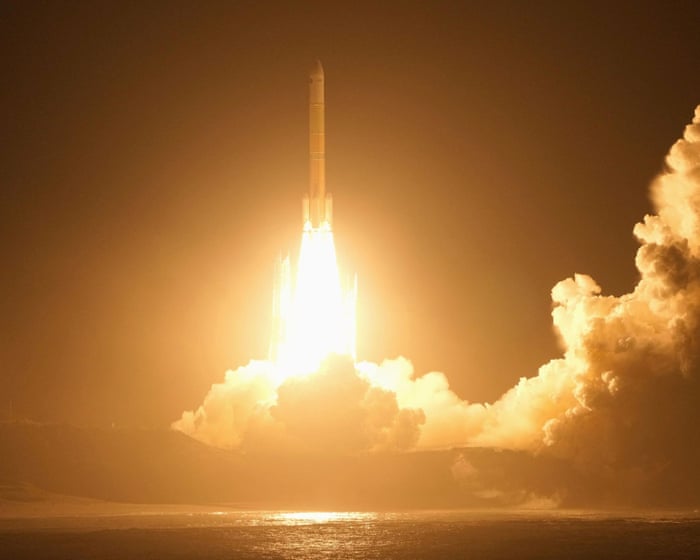
The Japan Aerospace Exploration Agency (Jaxa) on Tuesday successfully launched its Martian Moons Exploration (MMX) spacecraft before dawn from Tanegashima island in the country's far south-west. The probe is to bring back samples from Phobos, a moon of Mars, which scientists hope will shed light on the origins of the solar system and of life on Earth.
Japan's flagship H3 rocket lifted off with the unmanned probe from Tanegashima Space Centre at 4:41am. An hour later, when the spacecraft separated from the rocket's upper stage, Jaxa scientists declared the launch a success, and celebrations broke out in the flight control room.
The plan
The spacecraft is expected to reach Mars's orbit next August and collect at least 10g of soil and rock from Phobos. The moon is 22.5km across and circles Mars three times a day, about 6,000km above the surface. The return to Earth is scheduled for 2031.
The mission costs $578m. The five-tonne spacecraft will match Phobos's orbit and release a small French-German rover called Idefix, named after the white terrier in the Asterix comics. Gravity on Phobos is a thousandth of Earth's, so the rover will bounce for several minutes after touchdown before it stops. It will then spend 100 days surveying the surface for safe landing and sampling sites.
The four-legged stationary main lander will follow. It will spend only two hours on Phobos, drilling and vacuuming up material, before lifting off again. Before leaving Mars's orbit in November 2030, the spacecraft will make several flybys of the other moon, Deimos.
Scientific significance
Two hypotheses exist for the origin of Phobos and Deimos: either they formed after a celestial body struck Mars, or they are asteroids captured by Mars's gravity. Jaxa says the answer will help reveal how a habitable environment might have arisen on the terrestrial planets. Nasa adds that the findings will inform future Mars missions, including crewed ones.
Five space agencies are working together on the project. Markus Grebenstein, rover chief at the Germany Space Agency, called it a once-in-a-lifetime chance. Meanwhile, the US and China are racing to be first to return samples from Mars itself; China's Tianwen-3 could do so as early as 2031.