New high-powered microscope could reveal root causes of incurable bowel disease
UK scientists have unveiled a unique microscope capable of imaging gut tissue in unprecedented detail, offering hope for understanding inflammatory bowel disease. The launch coincides with new government funding for research institutes.
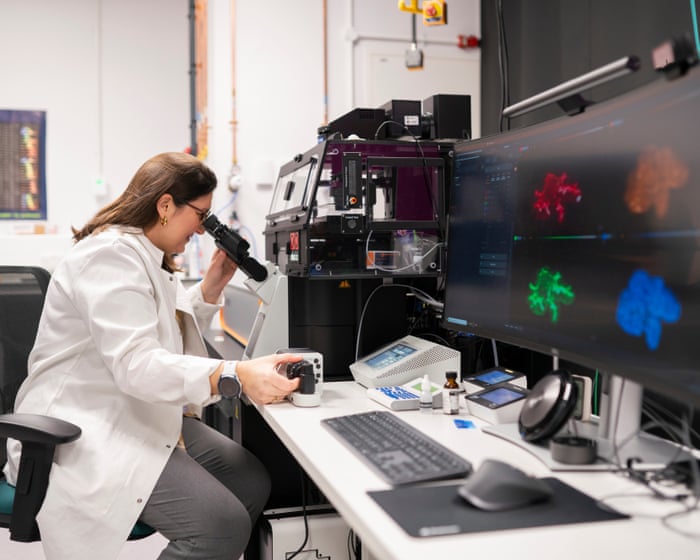
A newly installed microscope at the Rosalind Franklin Institute, based at the Harwell Science and Innovation Campus in Oxfordshire, could help scientists uncover the underlying causes of inflammatory bowel disease (IBD). Nicknamed "Curie" by researchers, the device operates at ten times the resolution of conventional light microscopes, revealing details as small as 20 nanometres.
The microscope relies on stimulated emission depletion (STED) microscopy, a two-laser technique whose inventors won the 2014 Nobel Prize in Physics. The method allows structures positioned far closer together than a standard fluorescence microscope could distinguish to be seen clearly. Additional features include deformable mirrors that correct for distortions within tissue samples, and a temperature-controlled stage that lets researchers study living cells and mini-organs under near-body-temperature conditions.
According to the British Society of Gastroenterology, more than half a million people in the UK live with IBD, the two main forms being Crohn's disease and ulcerative colitis. The conditions are most often diagnosed between ages 15 and 40, disrupting education, careers and relationships at a pivotal life stage.
Dr Karina Pombo-Garcia, a group leader at the institute, said existing IBD treatments are often not well targeted because the underlying disease mechanisms remain poorly understood. PhD student Dimitrios Ioannidis is using the microscope to study how cells lining the intestines form protective barriers via protein complexes that may change over a person's lifetime, from foetal development into adulthood. By comparing healthy and diseased tissue, researchers hope to identify what goes wrong at a structural level.
The microscope was unveiled by UK science minister Chris McDonald alongside an announcement of £67m in funding for the Rosalind Franklin Institute over five years starting April 2027, plus £90m for the Henry Royce Institute over the same period. The news comes as other facilities on the same campus, including the Diamond Light Source and Central Laser Facility, face funding cuts of up to 15%.
