Cambridge Scientists Build a $10 Chip That Could Enable Needle-Free Health Monitoring
Researchers at the University of Cambridge and its spin-out GlitterinTech have developed a miniature optical spectrometer costing about $10. In tests it also measured glucose accurately, though further testing is needed before medical use.
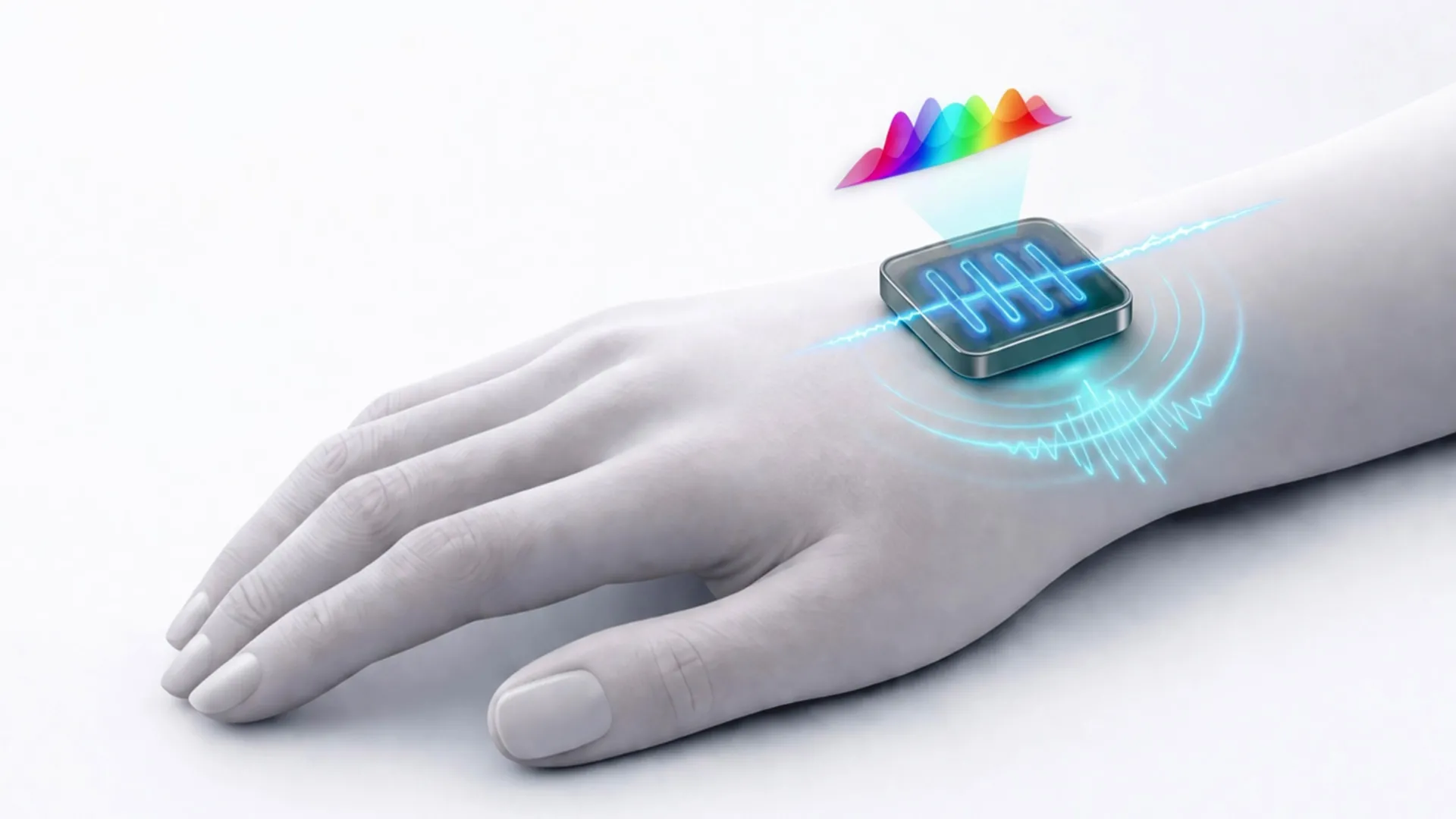
Researchers at the University of Cambridge, working with GlitterinTech, a start-up founded by the same research group, have developed a new type of optical spectrometer that is only a few centimeters across and costs about $10. A spectrometer is an instrument that analyzes light to reveal what substances it has interacted with. The developers say the device could be built into wearable health monitors and might allow people to track blood glucose without needles.
Why it matters
Shrinking spectrometers has traditionally meant sacrificing performance: compact models often have a limited measurement range, lower resolution or reduced accuracy, which makes them better at identifying substances than at making precise measurements. The Cambridge team believes its design overcomes these limitations.
How it works
The device is known as a convolutional spectrometer. It uses a mathematical principle, the convolution theorem, and applies the operation directly to incoming light. The researchers arranged optical components with repeating spectral responses in sequence, such as unbalanced Mach-Zehnder interferometers or micro-ring resonators. The light spectrum is then recovered using fast Fourier transforms. The spectrometer is built on a silicon nitride photonic platform with onboard electronics, operates across near-infrared wavelengths of 1200–1700 nm, and processes measurements in under a second.
Test results
When identifying plastics, pharmaceuticals, coffee, flour and tea, the device achieved a 100% classification success rate in the reported tests. It measured concentrations in water-based and organic solutions with accuracy of about 0.01%, exceeding commercial benchtop spectrometers in those experiments. Under conditions designed to reflect real physiological environments, it accurately measured skin moisture, blood alcohol, blood lactate and blood glucose. Glucose was also tracked noninvasively over an extended period in one participant. The sensor kept working reliably between -20°C and 80°C.
The researchers stress that more testing is required before the technology could become a practical medical product. They also see uses in industrial quality control, food freshness monitoring and environmental analysis. Project leader Prof. Qixiang Cheng said the aim is to make spectrometry as ubiquitous as temperature or motion sensing.


