The Chinese robot army transforming the UK's retail industry
Chinese robotics company Geek+ is rapidly changing UK warehouse operations, boosting efficiency and reducing errors. British retailers like Tesco and Next are using the robots to address labor shortages and productivity challenges.
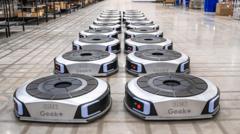
Chinese robotics company Geek+, headquartered in Hefei, has become the world's largest supplier of autonomous mobile robots. Its squat silver floor robots glide beneath storage racks, lift shelves, and carry them across warehouses to waiting workers, speeding up order processing and reducing errors.
Major UK retailers including Tesco, Asda, and Next now use Geek+'s technology. Unlike traditional automation with fixed conveyor systems, these robots operate using simple QR code floor markers and safety fencing, allowing faster deployment and flexible warehouse layouts.
The UK has become Geek+'s largest European market. Its partner MotionTech has deployed over 2,000 robots across 10 warehouse sites. Barry Pemberton, Account Director at MotionTech, notes that customers want fast, high-volume solutions with smaller footprints and reduced headcount.
Britain's weak productivity growth and labor shortages are driving demand for automation. According to an OECD report on SME technology adoption, the UK's low robotics uptake is "surprising" given its manufacturing heritage, and these technologies are key to improving productivity.
However, the Trades Union Congress (TUC), representing nearly 6 million workers, urges that robotics should boost productivity and improve jobs, not just cut costs. It calls for worker involvement in automation decisions and employer investment in retraining.
In China, robotics is a strategic priority under President Xi Jinping's vision of "new quality productive forces." Researcher Kyle Chan from the Brookings Institution notes that China's robotics sector benefits from overlapping ecosystems with electric vehicles, sharing batteries, motors, and sensors.
Chinese EV maker XPeng unveiled its humanoid robot Iron last year. Founder He Xiaopeng sees XPeng as a high-tech company, not just a carmaker. However, experts agree that current humanoid technology lacks dexterity for many repetitive tasks and may be complementary rather than transformative in warehouses. Chinese companies dominate global humanoid deployments, but widespread use in UK warehouses may be years away.