Kuldīga hosts international contemporary jewellery exhibition "Jewellery Parade"
The Adatu Fabrika venue in Kuldīga is showing "Jewellery Parade," an international contemporary jewellery exhibition created alongside a summer school, exploring the theme of the jewellery box. Artists from Latvia, Australia, Switzerland, Belgium and other countries take part.
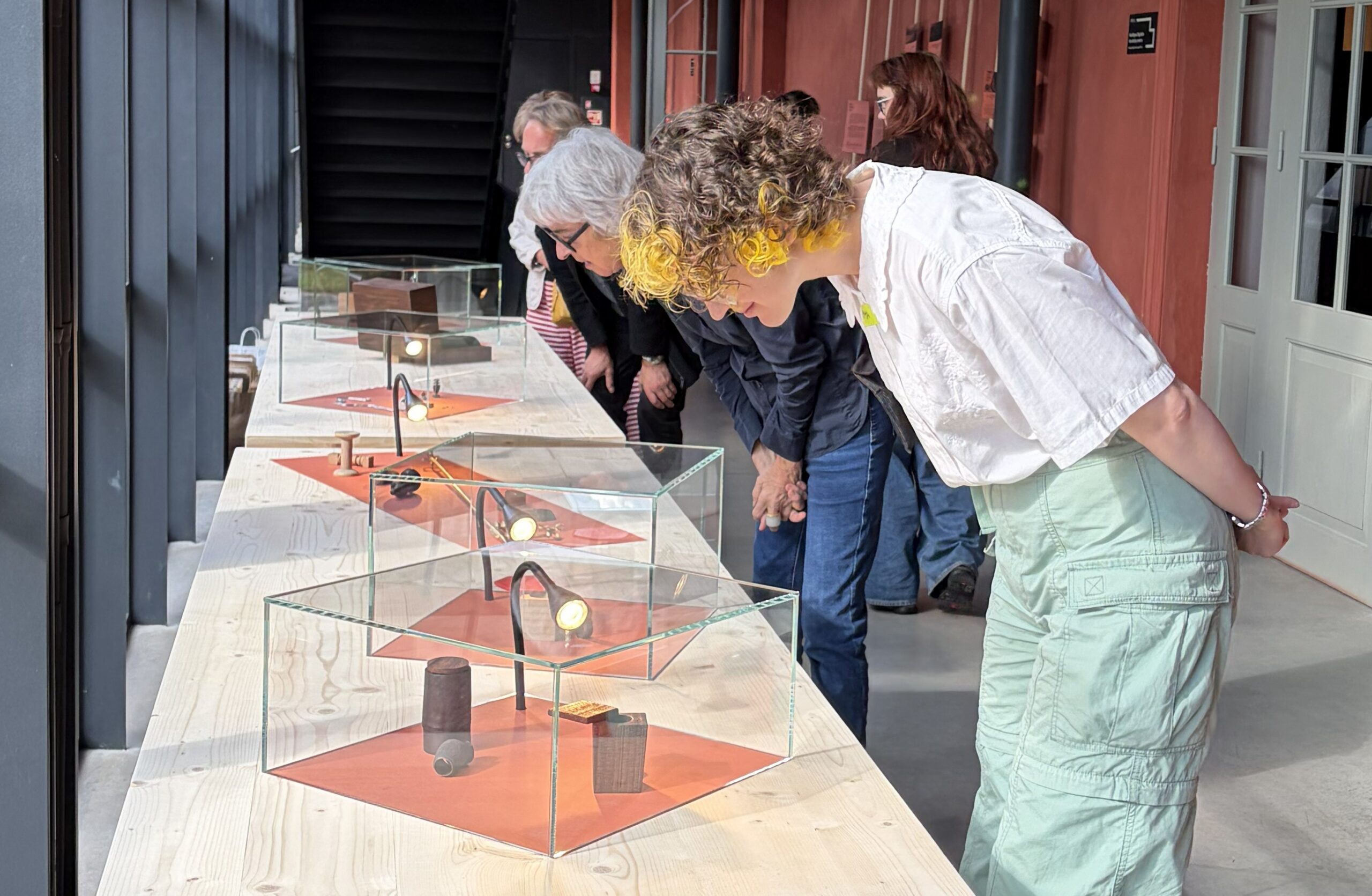
The Adatu Fabrika (Needle Factory) venue in Kuldīga is currently hosting "Jewellery Parade," an international exhibition of contemporary jewellery art. The show grew out of a summer school held at the venue, whose participants focused their work on the theme of the jewellery box.
The exhibition's curator is jewellery artist Ginta Grūbe, who teaches the history of jewellery at the Art Academy of Latvia. Through the exhibition she aims to popularize contemporary jewellery art, bringing together foreign and Latvian creators in a shared international context.
Works that blur the line between art and function
One highlight is Latvian artist Ildze Bogana, a graduate of the Royal Academy of Fine Arts Antwerp. Her pieces give everyday objects new meaning — one work reimagines a litter-picking tool as a mechanism for collecting and holding found treasures, an idea she developed after noticing a similar mechanism in sugar dispensers in Antwerp.
Another of Bogana's works is a piece of jewellery that doubles as a treasure box, fitted with a lens and a screen that shows the wearer's face from below when the item is worn. Its materials come from old cameras and camera cases. Bogana also created a chess king figure for the exhibition, part of a larger series of objects originally made for her master's thesis.
Foreign artists are also represented: Australian artist Rosanna Bartley shows rings made from mulga wood, while Amsterdam-based artist Lisbeth Busch created an unwearable jewellery box featuring the illusion of a pearl-and-silver necklace. The curator says she deliberately chose artists whose works provoke viewers to question the boundary between jewellery as art and jewellery as function.
Many of the participating artists were found through personal contacts and recommendations — including Swiss artist Esther Brinkmann, who also led the summer school, and others the curator met at professional events or learned of through colleagues' suggestions.


