Queensland Awards A$15 Million for Metal and Ceramic 3D Printing at Artillery Shell Plant
Australia's Queensland state has granted NIOA up to A$15 million (about US$10 million) to set up an industrial metal and ceramic 3D printing line at its Maryborough plant. The printed parts are meant for missiles, rocket motors, drones and counter-drone systems.
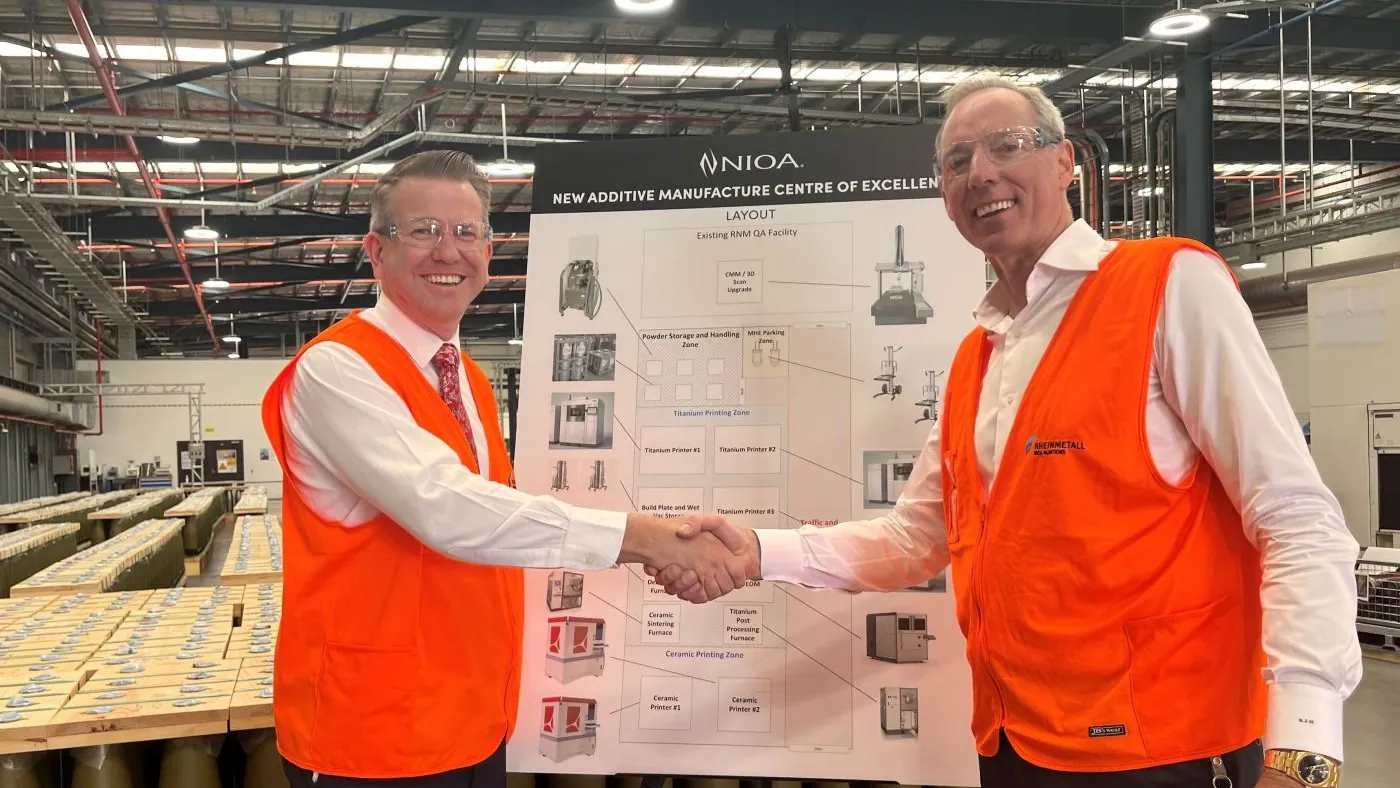
The Australian state of Queensland has granted defence company NIOA up to A$15 million (about US$10 million) to add an industrial metal and ceramic 3D printing line to the Rheinmetall NIOA Munitions artillery shell plant in Maryborough. Deputy Premier Jarrod Bleijie announced the grant on November 25. The printers are intended to produce parts for missiles, rocket motors, drones and counter-drone systems, with the line due to be fully running by late 2028.
Funding
The grant comes from Queensland's A$180.6 million Sovereign Industry Development Fund and covers about half of a A$29.85 million project. According to the state government, it lifts defence spending through the fund beyond A$90 million.
Rheinmetall NIOA Munitions is a joint venture with Germany's Rheinmetall. The plant opened in 2022 and forges and machines 155mm artillery shell bodies. The state describes the new line as Australia's first industrial-scale ceramic 3D printing production capability.
NIOA's release adds two post-print sintering ovens, a prototype oven and up to 18 jobs. It says the ceramic parts are for "high-speed defence systems", which it does not name.
Discrepancy between announcements
NIOA's formal release lists three ceramic and two metal 3D printers. The layout board behind Bleijie and NIOA CEO Rob Nioa in the company's photo shows three titanium printers and two ceramic ones, plus a titanium post-processing furnace and a ceramic sintering furnace. The release does not mention titanium. Neither announcement names the printer supplier or says which drone or counter-drone parts will be made first.
Earlier work
NIOA already works in the counter-drone field. In April it agreed to deliver an inert proximity fuze and an effector payload, and to design a fragmenting warhead, for SYPAQ's Corvo Strike interceptor, which is being developed under Australia's ASCA Mission Syracuse program. That agreement came days after Canberra set out plans to spend up to A$7 billion on counter-drone capability.
