London scrambles for solar eclipse glasses amid price surges and secret WhatsApp 'drops'
Ahead of a near-total solar eclipse over western Europe, Londoners queued for hours and paid double or more for protective glasses, coordinated via a secretive WhatsApp group tracking shop restocks. Eye specialists warn that viewing the eclipse without certified glasses can cause permanent retinal damage.
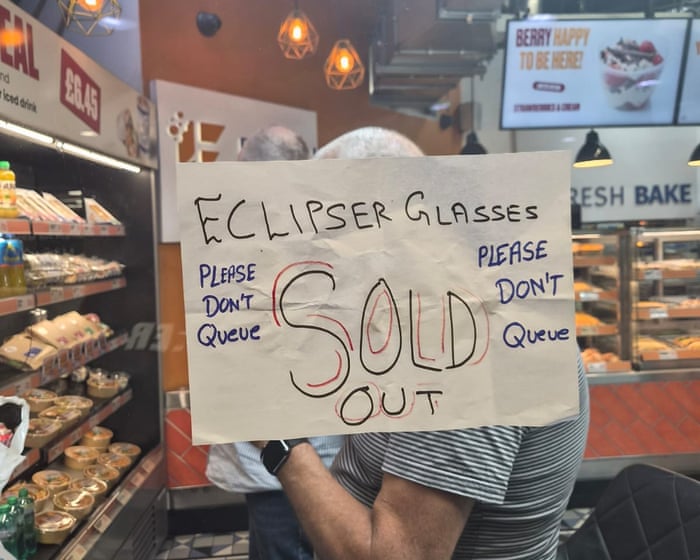
As western Europe prepared to witness a near-total solar eclipse for the first time in more than 25 years, a frenzy broke out in London over protective eclipse glasses. Long queues formed outside corner shops in the early hours of Wednesday as customers hunted for the increasingly scarce eyewear.
A secretive WhatsApp group buzzed with notifications throughout the day, alerting members whenever a new 'drop' of glasses became available at a shop somewhere in the city. Glasses that sold for about £5 weeks earlier were being resold for double that price by shops lucky enough to secure late stock. Outside Whitechapel tube station, an improvised stall sold glasses for £10 each, while a Reddit user advertised pairs near Camden Town station for £20 apiece.
The rush also sparked tension. One shopkeeper appealed to a WhatsApp group to ask customers to treat staff respectfully, citing complaints of threats over bad reviews. Ali Raza, owner of the AM2PM convenience store in Whitechapel, said customers had travelled from as far as Surrey, Southend-on-Sea, Southampton and Birmingham. He said his shop sold 6,000 pairs on Wednesday alone, selling out within hours of a delivery from Spain that arrived at 2.30am.
The Royal Greenwich Observatory said it had sold more than 15,000 pairs over the past month and had now run out. Exmoor national park also sold out, with a spokesperson noting it would not need another batch until the next relevant eclipse in 2081. Branches of Sunglass Hut reportedly had to post signs clarifying they did not sell eclipse glasses after being overwhelmed with enquiries.
Ophthalmology lecturer Panayiotis Maghsoudlou, of the University of Bristol, explained that during an eclipse the eye's normal protective reflexes are dulled, allowing people to stare comfortably at the exposed sliver of sun for minutes without realising the damage being done, since the retina lacks pain receptors and symptoms only appear afterwards. After the 1999 eclipse, 70 cases of vision loss were reported, and Moorfields Eye Hospital in London logged 1,600 helpline calls and treated 220 patients. Experts also warned of counterfeit glasses circulating and urged buyers to use only eyewear certified to the ISO 12312-2 safety standard.