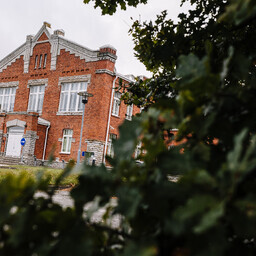
Mere Culture Center to cover ceiling mural as many feel unease and even fear
The Mere Culture Center in Tallinn, formerly the Russian Culture Center, will cover a ceiling mural depicting Soviet soldiers and Stalinist symbols to attract more tenants. Historians acknowledge the artistic value but understand the decision.

The Mere Culture Center in Tallinn, previously known as the Russian Culture Center, will cover a ceiling mural featuring Soviet soldiers and Stalin-era symbolism. The management decided to do so to attract more tenants, as many potential renters feel anxiety and fear towards this imagery.
The mural shows Soviet soldiers in dress uniform against a blue sky and bright sun, their gazes fixed on a bright future. Behind them are the Tall Hermann tower with the Soviet Estonian flag and the bows of warships.
Architecture historian Oliver Orro notes that the mural represents Stalinism in its most frightening form, portraying the Soviet occupation of Estonia as a natural continuation of history. However, he acknowledges that as an artwork it is very coherent and perfect, created by masters of the St. Petersburg academic school.
On Wednesday, July 1, scaffolding will be erected in the hall to hide this Stalin-era monument. Center director Kert Talistu explains that many people refuse to come into the hall because they feel wariness and even fear. Therefore, the most sensible solution is to cover it without damaging the original work.
The project has been approved by the Heritage Protection Department. Large five-pointed stars will be covered with relief flowers, and the hammer-and-sickle emblem will be removed and placed in the center's museum room. The painted ceiling will be covered with white fabric that does not harm the painting, as no fastenings will be attached directly to it. The fabric gives the appearance of an ordinary white ceiling and can be easily dismantled if needed.
Orro says that as a historian, he regrets that the mural will be covered, as it disrupts the building's integrity. However, as long as it frightens people, it should be hidden for a while, with periodic checks on its condition. In 100 years, perhaps it will no longer cause fear, and it can be uncovered again and viewed simply as part of history.