Rare Nanotyrannus skeleton sells for $47.3m at New York auction
A rare skeleton of Nanotyrannus, a smaller relative of T. rex, sold for $47.3m at Sotheby's in New York, the second most valuable dinosaur ever sold at auction. Some scientists have criticised such private fossil sales.
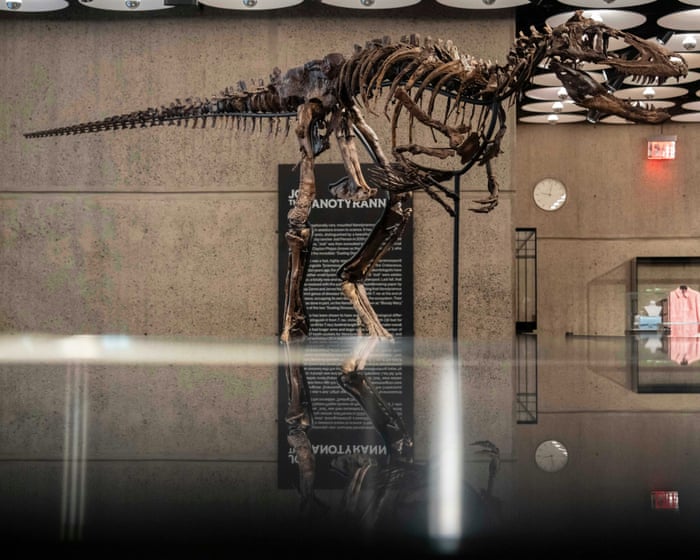
A skeleton of Nanotyrannus, a smaller tyrannosaur related to Tyrannosaurus rex, was sold on Tuesday for $47.3m at a Sotheby's auction in New York. The auction house says it is the second most valuable dinosaur ever sold at auction. The buyer has not been publicly identified.
The sale and the discovery
The specimen is nicknamed "Jodi" after Jodi Pierson, who found it in 2019 on her privately owned land in the Hell Creek Formation in Garfield County, Montana, near the town of Jordan. Sotheby's says it is about 19.6ft long and around 9.6ft tall on its mount, and is made up of roughly 191 fossil bone elements. Based on its size and the degree of bone development, it belonged to an adult.
Sotheby's had initially estimated a price of $6m to $9m. Six bidders competed online and by phone over twelve minutes, and the skeleton ultimately sold to a phone bidder.
According to Sotheby's, it is one of only three substantial Nanotyrannus skeletons known to science and the first to reach the market since the genus was confirmed last autumn. The animal lived alongside T. rex at the end of the Cretaceous, about 67 million years ago. Some had previously suggested it was a juvenile T. rex, but Sotheby's cites more than 150 morphological differences between the two.
Criticism from scientists
The sale has drawn criticism from some in the scientific community. Thomas R Holtz Jr, a vertebrate paleontology lecturer at the University of Maryland, noted that museums such as the Academy of Natural Sciences at Drexel in Philadelphia are closing, and the Sternberg Museum of Natural History at Fort Hays State University is threatened with closure, over cost overruns about a tenth of Jodi's price. He estimated that excavating, preparing and mounting such a skeleton costs about $1m at most, and warned that fossils in private hands can be lost to research and the public.
Linda Ivany, a professor of evolutionary paleoecology at Syracuse University, told the New York Times that such fossils should remain in the public sphere for scientists to study and for children to be inspired by.