NASA and IBM unveil AI model for lunar exploration
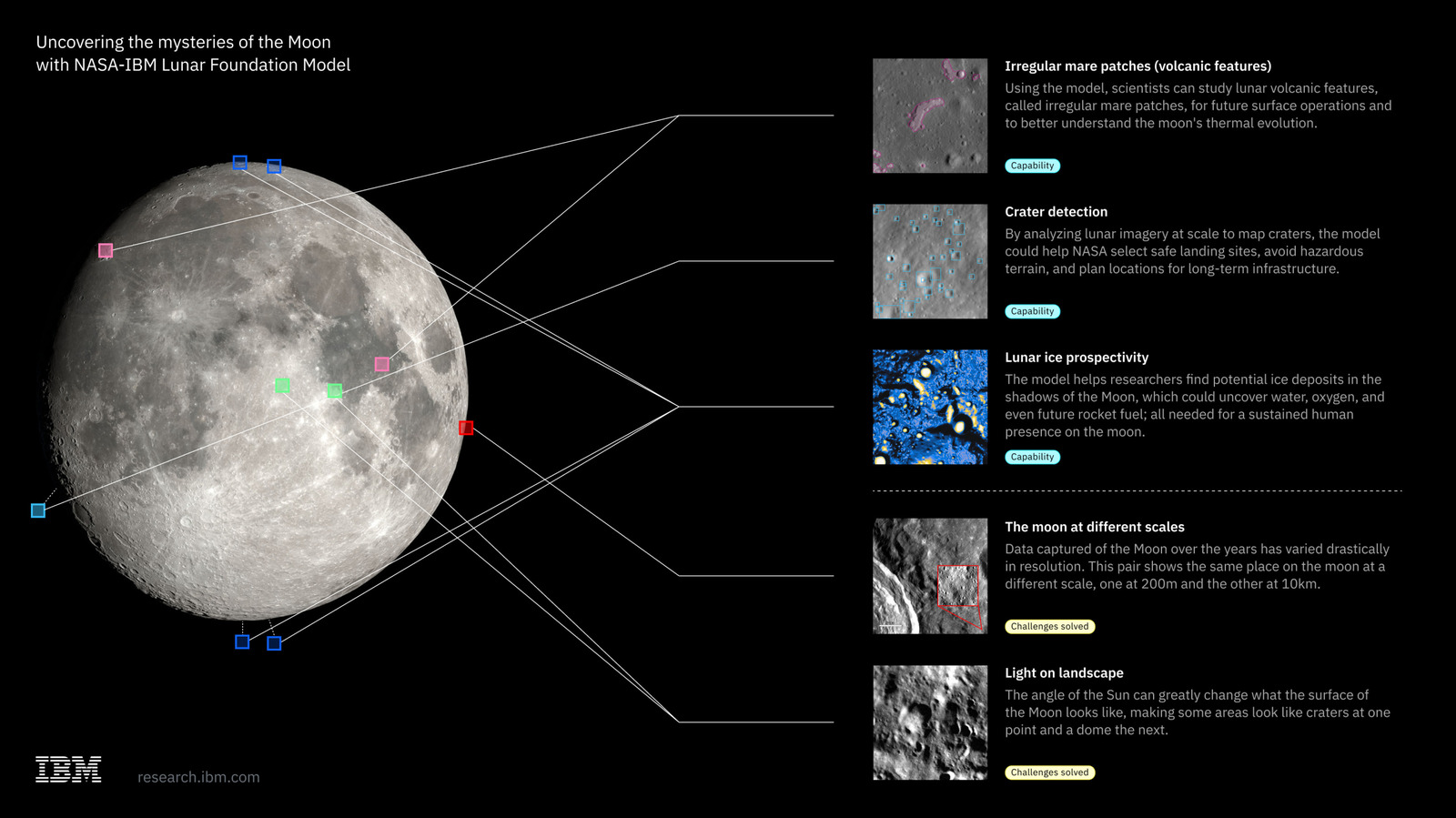
NASA and IBM have released an open-source AI model for analyzing the Moon's surface along with a new research dataset. The model has already shown strong accuracy in locating potential ice deposits and identifying new impact craters.
Following NASA's Artemis II mission in April, which saw astronauts fly around the Moon for the first time since 1972, the agency is preparing for upcoming mission phases. As part of that effort, NASA has partnered with IBM to give researchers a new tool for studying the lunar surface: an open-source AI system released Thursday for download on Hugging Face.
According to IBM's Juan Bernabé-Moreno, the model is especially effective at identifying locations on the Moon's surface that may contain ice. When tested against Microsoft's SwinV2-B, a widely used baseline for image analysis tasks, the new model reduced errors by 23 percent. It also outperformed SwinV2-B by 19 percent at identifying and classifying craters, while using only half the training data.
The model's abilities were put to a real test in August, when a stage of a SpaceX Falcon 9 rocket crashed into the Moon. Fed an image of the impact, the model correctly identified the site as a new crater, even though it closely overlapped with an existing one.
Training the system proved difficult, since lunar imagery differs greatly from Earth observation data. Unlike on Earth, where the atmosphere scatters light, shadows on the Moon are sharply defined and completely black, leaving no usable information in those pixels. The standard training approach, which asks a model to reconstruct hidden parts of an image, also failed initially because many craters look alike from orbit. Researchers solved this by dividing the Moon into wedge-shaped sections, like an orange, and keeping the training and testing areas strictly separate.
Along with the model, NASA and IBM released a large, co-registered dataset containing tens of thousands of images drawn from NASA's LRO and GRAIL missions as well as Japan's SELENE mission, which other researchers can now use to build future models.