Leaked Documents Reveal Repeated Delays and Problems in Russia's Sarmat Missile Program
Leaked internal documents show that Russia's RS-28 Sarmat intercontinental ballistic missile continues to face significant delays and production issues, despite the Kremlin's repeated announcements about its imminent deployment.
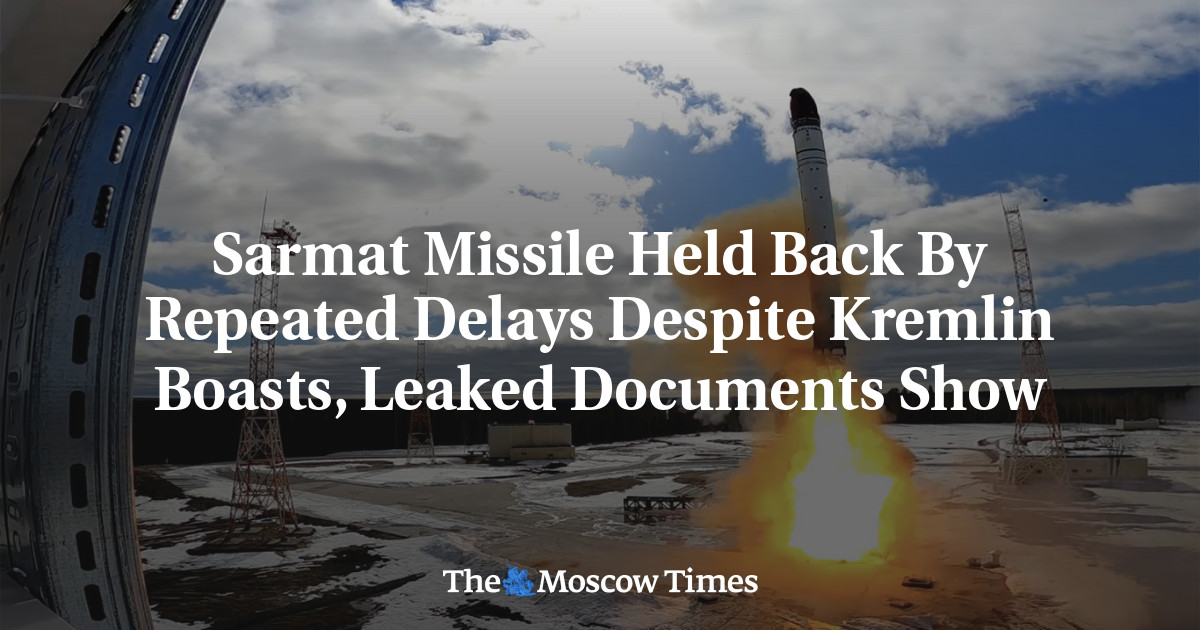
The deployment of Russia's flagship RS-28 Sarmat intercontinental ballistic missile has been plagued by failures for years, according to leaked internal documents that reveal systemic problems in its production and delivery.
In May, Moscow announced that the missile would be put on combat duty by the end of the year—the third public deadline after promises made in 2022 and 2023. The leaked documents, published by analytics firm Dallas Analytics, provide a behind-the-scenes look at how Russian defense manufacturers and agencies tried to meet Kremlin deadlines, often at the expense of standard procedures.
According to the documents, preparations code-named "Theme 001" were made in October 2022 to move missile components to the 62nd missile division in Uzhur, Krasnoyarsk region. However, due to a shortage of wagons, the Strategic Rocket Forces could only send one rail transporter instead of the required two, delaying the delivery of C286 components—believed to be payload fairings. The first of these components was shipped without a formulyar, an official technical logbook confirming the missile's condition and service life, indicating a departure from standard procurement procedures.
Another issue was pricing. A letter dated October 2020 requested permission to ship C286 components without a finalized price. Correspondence from Roscosmos in 2025 indicates that the price for "Theme 002" hardware was still being negotiated and had not been registered with the Federal Antimonopoly Service, nearly three years after the first units were shipped.
Experts note that the Sarmat is primarily intended as a strategic nuclear deterrent, not a battlefield weapon, and Russia is unlikely to produce it in large numbers. A former Russian defense engineer said in 2024 that new missile systems typically require years of testing before mass production begins.
The gap between the Kremlin's nuclear posturing and actual production capability has become harder to assess since Russia suspended its participation in the NEW START treaty in February 2023. In September 2024, Western analysts concluded that a Sarmat test at the Plesetsk Cosmodrome suffered a "catastrophic" failure.


