Pärnu Beach House extension designed to become a new city landmark
Estonian architecture firm Kamp Arhitektid has won a competition to modernize Pärnu's historic Beach House and the Soviet-era Villa Andropoff complex, adding a new hotel volume while preserving the buildings' character.
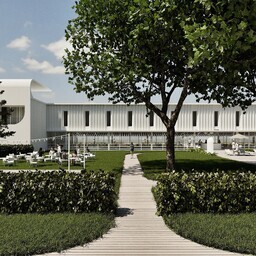
Two significant buildings in the Estonian city of Pärnu are set for modernization: the Beach House, designed by architect Olev Siinmaa and completed in 1938-1939, and the Soviet-era Villa Andropoff complex. An architectural competition held in autumn 2025 sought a way to connect the historic Beach House with a modern hotel and new volume while preserving its original style. The winning entry, "Alt Pernau," was submitted by Kamp Arhitektid, authored by Jan Skolimowski, Anton Andres and Kaspar Kruuse.
Skolimowski said the building holds special meaning for him as a symbol of Pärnu, and the priority in designing the new addition was preserving the character of the original, including its recognizable "mushroom" balcony. Site visits revealed that while the seaside façade is representative, the park-side façade resembles a service building, so the project aims to make that side representative as well.
Underground connection
Because the old and new buildings could not be linked at street level, the connection was designed underground and via a second-floor gallery. Rather than copying the historic building, the new design develops its characteristic features — rounded forms, the mushroom balcony motif, and small corner arches. Archival material and old photographs were used to restore the original façade, part of which had been damaged by a Soviet-era extension.
White concrete was chosen as the key material for the new building, creating a direct link to the original structure through elements such as the mushroom, beams, columns and canopies. A light canopy is planned on the seaside to shield hotel rooms from the sun while forming a new entrance, and a modern reinterpretation of the mushroom motif is planned at the other end of the building.
The project aims to open the building further to residents and beachgoers, including plans for a café and smaller beachside services. The architect said the dominant element at the end of the building should serve as a new landmark, visible from both the promenade and the sea.
The Villa Andropoff project posed a more complex challenge, as it involves two markedly different existing buildings — the angular main building by Raine Karp and the softer-formed cinema building by Meeli Truu. The team decided to give the new building its own distinct character, connecting it to Karp's main building only underground, so the two historic structures remain visually separate. In cooperation with the developer, an earlier plan for a larger, four-story new hotel building was also dropped in order to preserve sea views.