Study finds climate crisis likely contributed to Nepal-Tibet floods that killed over 1,300
The first scientific study of last month's catastrophic Nepal-Tibet floods concludes that climate breakdown probably weakened the glacier whose collapse triggered the disaster, which killed more than 1,300 people and left over 5,000 missing.
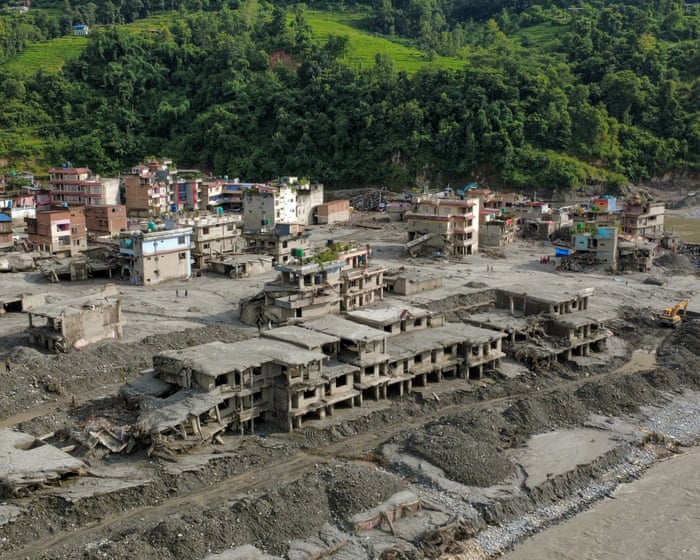
Researchers from Imperial College London have found that climate breakdown likely weakened a glacier on Langtang Lirung mountain, whose collapse on 26 August triggered catastrophic flooding in Nepal and Tibet. The disaster killed more than 1,300 people, with over 5,000 still missing.
An overhanging section of glacier and rock covering roughly 200,000 square metres broke away and fell about 1,400 metres, striking the valley floor with enough force to register as an earthquake. The impact liquidised ice and unleashed a flash flood that raced downriver at speeds exceeding 110mph, destroying homes, roads, bridges and entire settlements.
Clear signs of climate influence
The World Weather Attribution research team found that the region has warmed by about 2C since pre-industrial times, and by roughly 1.5C in July and August specifically. July and August 2026 were the warmest on record locally, with temperatures reaching 5C above the 30-year average in the days before the collapse.
The study also found that the freezing threshold in the Himalayas has risen by about 100 metres per decade since the 1980s, weakening permafrost-supported mountain slopes. Long-term warming had already caused significant glacier recession, removing ice that had stabilised the site and adding meltwater to the system. A magnitude 7.8 earthquake in 2015 may also have contributed to slope failure, though researchers could not confirm its specific role in August's collapse.
Scientists noted that rock avalanches of this scale are extremely rare, occurring roughly once every 1,000 to 10,000 years, and said the event shows that limits to adaptation are already being reached.
Call for support
Nepal has formally requested assistance from the UN's loss and damage fund, a process requiring proof of a link to climate change. The country's foreign minister, Shisir Khanal, has called on major emitting nations, including China and India, to accept shared responsibility for the disaster.