Researchers devise a full-color night vision device
A team at the Beijing Institute of Technology has built a device that converts infrared light into full-color visible images using quantum dots and an OLED. The technology also triggered visual responses in mice and human volunteers.
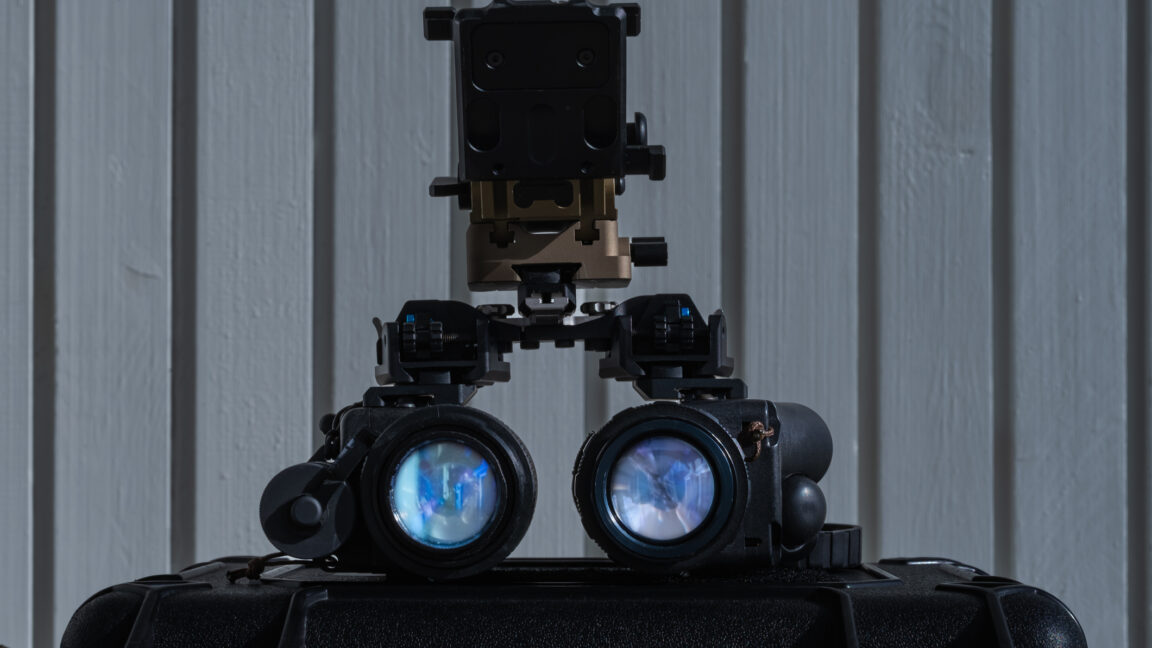
Researchers at the Beijing Institute of Technology, led by Xin Tang and Ge Mu, have developed a device that converts infrared light into full-color visible images. Conventional night vision systems typically render infrared scenes in monochrome shades of green, relying on brightness alone. The new approach assigns different infrared wavelengths to distinct parts of the visible spectrum, producing a more natural-looking image.
The technology combines mercury telluride colloidal quantum dots, which absorb infrared light, with a two-layer OLED that emits visible color. Because the quantum dots are only about four nanometers across, quantum confinement creates discrete energy levels. Incoming infrared photons with different wavelengths and intensities trigger different electronic transitions, generating varying numbers of charge carriers. Shorter wavelengths and brighter light produce more positively charged holes, which travel toward the OLED.
The OLED has two stacked emissive layers separated by an energy barrier of roughly 0.82 electron volts. The layer closest to the incoming holes emits red light, while the farther layer emits cyan. When few holes arrive, only the red layer lights up. As the number of holes increases, the barrier is overcome, and cyan emission joins in, shifting the overall color and brightness. This means the output color encodes both wavelength and intensity. The researchers calculate the device can distinguish infrared power differences about 200 times smaller than a conventional brightness-only system.
The team also built semi-transparent eyeglasses weighing 23 grams, with an active viewing area of 3.57 square centimeters. In tests, the glasses projected sharp, color-coded images of test patterns and moving objects when illuminated by shortwave infrared light, while still transmitting ordinary visible light. The glasses could potentially switch between augmented-reality and infrared-only modes.
Experiments with living tissue showed that upconverted infrared light triggered photocurrents in cells expressing channelrhodopsin-2. Mice displayed electroencephalogram responses, and human volunteers showed electroretinogram responses to infrared pulses delivered through the device, while the pulses alone produced no response.
The study, published in Science Advances, is far from a finished product. Tests were conducted under controlled conditions with simple high-contrast patterns, not real-world scenes. The OLED requires an external power supply, and mercury telluride is a heavy-metal compound with no data on long-term skin contact or biocompatibility. The researchers describe their work as a step toward next-generation visual prosthetics, but an implantable device remains several steps away.

