Five Grandiose and Unusual Geoengineering Projects That Could Have Reshaped Earth's Climate
History is filled with ambitious geoengineering schemes, from a Gibraltar dam to an artificial moon – all remained on paper.
An increasing number of scientists argue that the climate crisis has become so severe that technological intervention may be the only hope. However, history offers many eccentric ideas for remaking the planet.
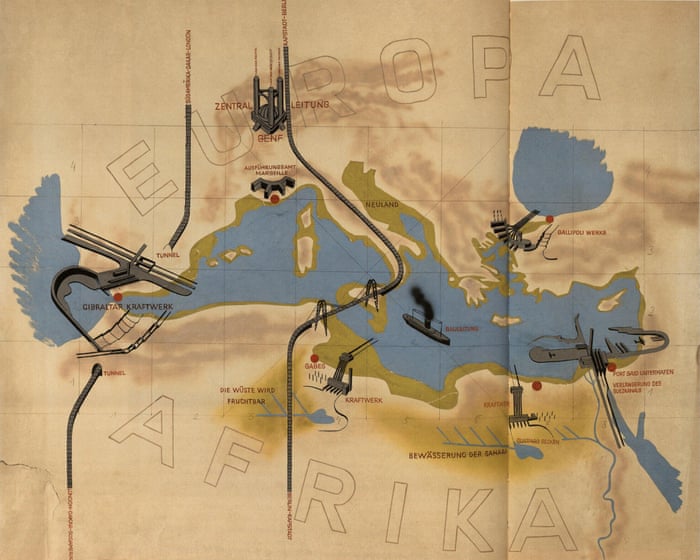
Atlantropa
In the 1930s, German engineer Herman Sörgel proposed building a dam across the Strait of Gibraltar to lower the Mediterranean Sea by 200 meters. This would create vast fertile lands worked by African laborers and provide limitless hydroelectricity. Despite significant support, engineers worried about impacts on cities like Venice. The Atlantropa plan survived until the 1960s.
Soviet Plans to Modify Nature
Russia historically felt shortchanged by climate, lacking heat. Engineer PM Borisov suggested a dam across the Bering Strait to melt the Arctic ice cap. Other Soviet scientists countered by proposing to cut a 3,000 sq km hole in the Thompson-Wyville Ridge. These ideas stemmed from Stalin's “great plan for the transformation of nature,” discussed for decades after his death despite economic protests.
Bombing to Save the Planet
Harry Wexler, head of the US Weather Bureau's scientific division from the 1940s to 1962, believed ten hydrogen bombs could eliminate Arctic ice. The Soviet Union also tried using nuclear weapons to redirect rivers, detonating three devices, but only cleared 700 meters of canal and faced radiation issues.
Making a Second Moon
In the 1990s, Project Znamya actually created a “second moon,” though on a smaller scale. It involved reflective foldable satellites to illuminate Russian Arctic regions, increasing daylight. The first satellite produced a 5 km patch of light. After a second batch got stuck on the MIR space station and Russia's economy declined, the project was abandoned.
New Australian Mountains
In 1979, Laurie Hogan published “Man Made Mountain,” proposing a 2,000 km long, 4 km high, and 10 km wide mountain range in Western Australia. It would host 49 cities and 180,000 fish farms. When the book failed to gain support, Hogan formed the ‘Engineered Australia Plan party’, which contested the 1983 federal election. The plan required moving more rock than humanity had shifted in its entire history.
These five ideas are just the tip of the geoengineering iceberg. History includes serious attempts to increase rainfall, control hurricanes, and use weather in warfare – all unsuccessful. Now humanity faces a choice between geoengineering and adapting to a hostile climate.

