Total solar eclipse draws crowds to historic church in Spain
On Wednesday, the Moon's shadow swept across central Spain, giving observers near the village of Duratón a view of totality beside a centuries-old church. Hundreds of locals, tourists and photographers gathered at the site alongside ancient Visigothic and Roman ruins.
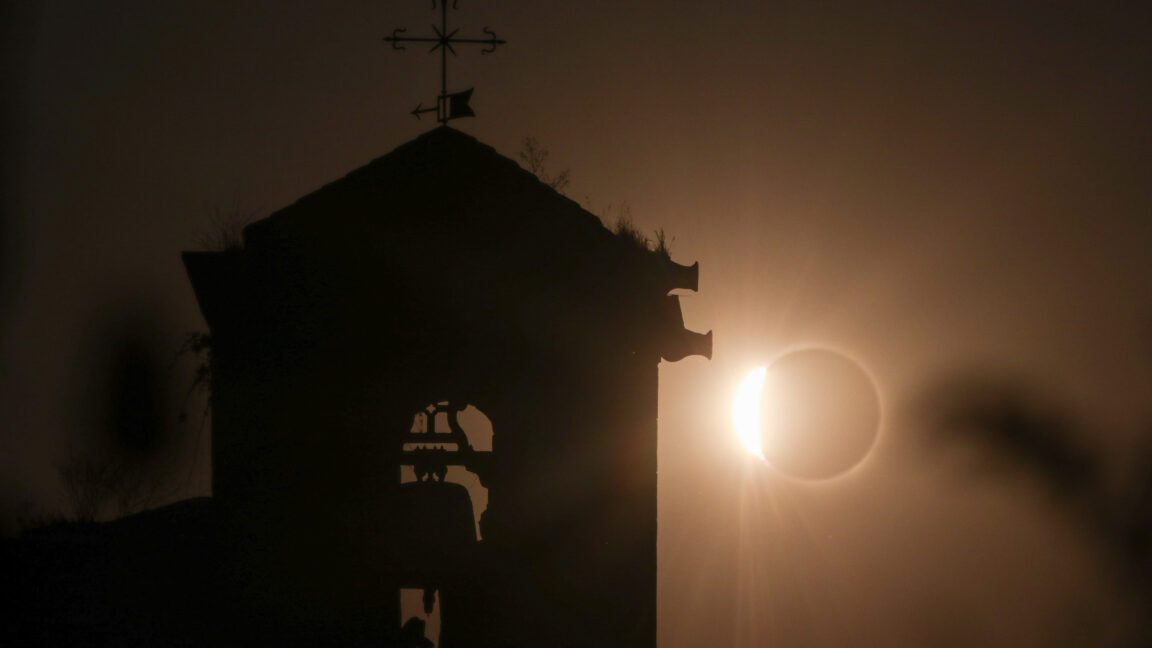
A total solar eclipse crossed central Spain on Wednesday, prompting many observers to gather at a rural site near the village of Duratón, roughly 100 kilometers north of Madrid. The location offered a little more than 1.5 minutes of totality, framed by the Romanesque Church of Our Lady of the Assumption, dating to the 12th or 13th century.
Observers scouted the site a day in advance to gauge what to expect. The church grounds offered ample parking and enough distance from larger towns to avoid the biggest crowds. Still, on eclipse day, a hundred or more local residents, tourists and photographers converged there with cameras, telescopes, music and drinks.
A layered history
The setting blended ancient and modern elements: the church stands next to a Visigothic cemetery containing anthropomorphic rock-cut tombs, while roughly 1,000 feet up the hill lie the ruins of the Roman city of Confloenta, still under archaeological study.
The moment of totality
Using eclipse glasses, spectators watched as the Moon gradually covered more of the Sun until, less than an hour before sunset, darkness fell. Church bells rang and the crowd cheered as the Sun's turbulent outer atmosphere became visible as a pale halo above the centuries-old church. Minutes later, sunlight returned, unfolding exactly as modern science had predicted.