Planned 1.7 Million Satellites 'Devastating' for Astronomy, Study Warns
A new study warns that plans to launch 1.7 million satellites will make the night sky up to four times brighter, threatening ground-based astronomical observations.
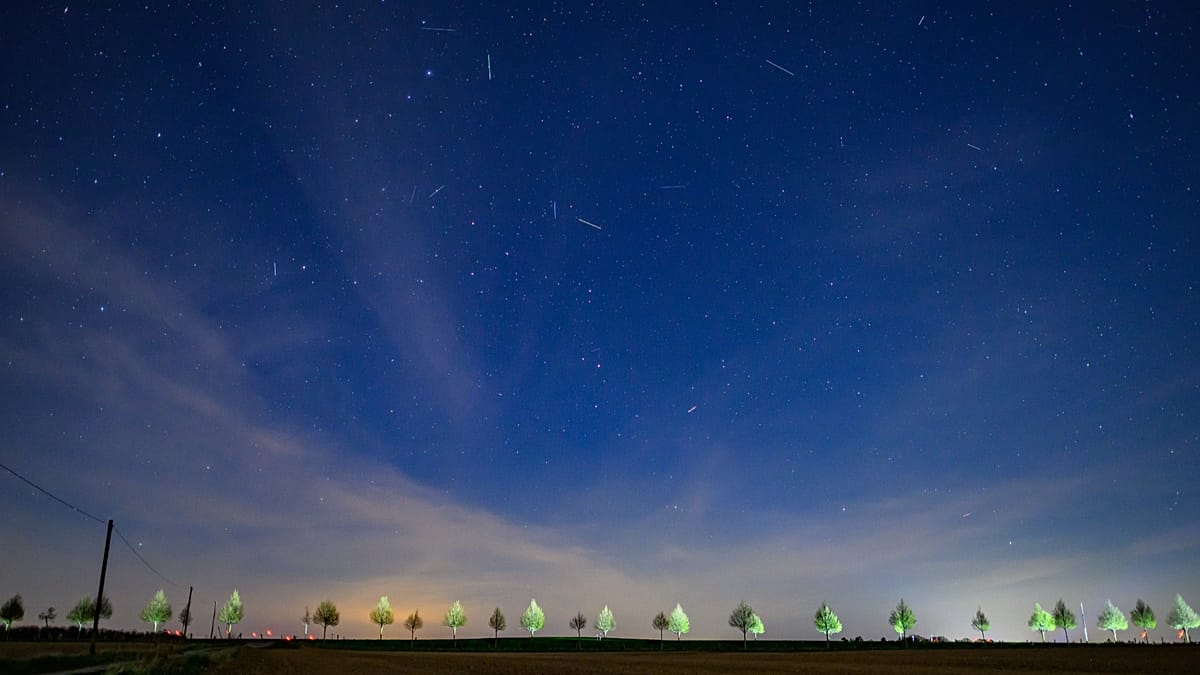
The European Southern Observatory (ESO) has released a study warning that companies' plans to launch over 1.7 million satellites into Earth's orbit will have 'devastating consequences' for astronomy. Currently, about 14,000 satellites orbit Earth, many part of Elon Musk's Starlink network. However, SpaceX plans to launch more than one million satellites by 2028 to serve as data centers for artificial intelligence. Other projects, including E-Space's 'Cinnamon' plan, Chinese constellations CTC-1 and CTC-2, and US startup Reflect Orbital's 50,000 giant mirrors designed to reflect sunlight back to Earth, would add hundreds of thousands more.
Researchers calculated that such a satellite swarm would make the night sky up to four times brighter, rendering most images from the new Vera C. Rubin Observatory in Chile unusable. Reflect Orbital's satellites would scatter so much light that each would be as bright as Venus. Even in remote areas like the Sahara Desert or France, the sky would resemble that of a suburb. ESO astronomer Olivier Hainaut warned that going from 14,000 to 1.7 million satellites would cause real problems for astronomy.
The study authors call for a limit of 100,000 satellites and for them to be dim enough to be invisible to the naked eye. A Reflect Orbital spokesperson said the company has commissioned independent research on its technology's impact and is committed to avoiding directing light near observatories. Both SpaceX and Reflect Orbital await a decision from the US Federal Communications Commission (FCC) on whether they can proceed. The ESO, along with the Royal Astronomical Society and the International Astronomical Union, has submitted responses to the FCC.
Beyond astronomy, light pollution from satellites can disrupt biological clocks in humans and animals and interfere with ecosystems. Concerns also include space debris and the potential for Kessler syndrome, where collisions trigger a chain reaction.

