Poland reviews winter rapeseed season after harsh winter and presents new varieties and crop protection
At the autumn Rapeseed Academy in Poland, experts reviewed the 2025/2026 season, when areas and yields came in below expectations. Companies also presented new varieties, crop protection products and fertiliser solutions.
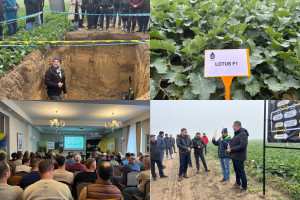
At the autumn Rapeseed Academy event in Poland, agricultural experts reviewed the 2025/2026 rapeseed season, which proved difficult in both Europe and Poland. The companies Rapool, Innvigo, Corteva Agriscience Poland and Timac Agro Polska discussed season results, new varieties, crop protection products and fertilisation.
Smaller areas and lower yields
Artur Kozera of Rapool said rapeseed was grown on about 9 million hectares in Europe in the 2025/2026 season. European Union countries together with the United Kingdom accounted for around 6.5 million hectares, and Eastern Europe for about 2.4 million. Germany, France and Poland were among the largest producers.
In Poland, the sown area was initially estimated at about 1.1 million hectares, but rapeseed was harvested from around 989,000 hectares. The reduction was linked to overwintering problems and unfavourable weather, notably a drought lasting from the second half of February to early May. The average yield in Europe was about 3.17 t/ha, compared with about 3.4 t/ha a season earlier. Polish production fell by about 17% year on year. For 2026/2027, the forecast area in Poland is 950,000 to 1 million hectares.
Sowing time and fertilisation
Rapool trials showed that delayed sowing in the second half of September can, in favourable conditions, give yields comparable to or higher than sowing at the optimal time, though this depends on the weather. Part of the nitrogen fertiliser was also tested for application in autumn. Destroying the rosette after winter reduced yield by 13–16%, while cutting the main shoot at the start of flowering reduced it by 3–11%.
Protection and varieties
Michał Filipowski of Innvigo noted that skipping necessary treatments to save money does not always pay off. The company presented a new insecticide, Catanga 200 SC, containing chlorantraniliprole. A Corteva representative stressed that seed treatment alone does not always protect against pests.
Rapool showed the new varieties Lotus, which averaged 4.24 t/ha in 2024–2026, and Guardian, which reached 4.45 t/ha in 2025–2026. Timac Agro stressed that fertiliser efficiency depends not only on the amount applied but also on soil condition and moisture.