Rutte: NATO Members Not United on Admitting Ukraine to the Alliance
NATO Secretary General Mark Rutte said in Berlin on Monday that member states currently have no consensus on Ukraine joining. He spoke after Ukrainian President Volodymyr Zelensky renewed his call for membership.
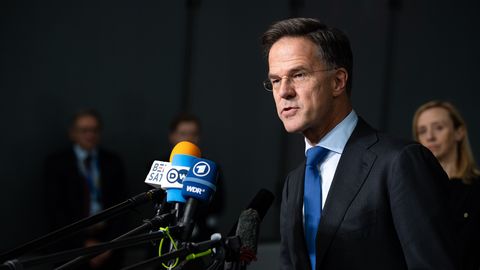
NATO Secretary General Mark Rutte stated in Berlin on Monday, 23 November, that the member states of the North Atlantic Treaty Organization, the military alliance of the United States, Canada and several European countries, are currently not in agreement on Ukraine joining the bloc. He made the remarks at the annual meeting of the NATO Parliamentary Assembly, responding to a renewed appeal from Ukrainian President Volodymyr Zelensky to admit his country.
A prospect exists, consensus does not
Rutte recalled that Ukraine has been granted a prospect of eventually becoming a NATO member. However, he said the allies' positions presently do not align. The secretary general also stressed that only NATO itself will decide which countries it admits.
He treated the question of whether Ukraine's membership could form part of negotiations with Russia as a separate matter. Rutte added that speculating about such talks is difficult because they have not yet begun: to speculate about negotiations, he said, there first have to be negotiations.
Praise for US efforts
Rutte welcomed the substantial efforts of the United States to get talks started, carried out in close cooperation with Ukraine and Europe. In his words, NATO needs Russian President Vladimir Putin to engage in the process so that it becomes clear how the war will end.
Zelensky's appeal
Zelensky addressed the NATO Parliamentary Assembly by video link on Monday morning. He said membership in the alliance would be a better solution for European security than security guarantees resembling the mutual defence clause in Article 5 of the NATO treaty.
Other positions
Russia opposes Ukraine's accession to NATO. The alliance has agreed in principle that Ukraine should become a member, but the United States has objected in recent years.