Red Cross warns thousands buried in Gaza rubble may never be identified
The International Committee of the Red Cross has expressed growing concern that thousands of Palestinians buried under Gaza's rubble may never be identified due to slow recovery efforts and advancing decomposition.
The International Committee of the Red Cross (ICRC) has warned that the chances of identifying thousands of Palestinians believed to be buried under the debris in Gaza are diminishing with each passing day. Recovery operations remain painfully slow, and many victims have yet to be retrieved.
Since the fragile ceasefire brokered by the US took effect last October, Palestinians have been sifting through an estimated 61 million tonnes of rubble—about 20 times the total debris generated by conflicts worldwide since 2008. According to Gaza health officials, at least 10,000 people are thought to be buried beneath the wreckage, with some experts estimating the figure could be as high as 14,000.
Rescue teams are forced to rely on rudimentary tools such as shovels, pickaxes, and wheelbarrows, often using their bare hands. Repeated requests for Israel to allow the entry of excavators and other heavy machinery, which would significantly speed up the search, have been ignored.
Pat Griffiths, ICRC spokesperson in Jerusalem, emphasized that the longer bodies remain unrecovered, the more difficult identification becomes. Forensic experts lose crucial circumstantial evidence, and remains deteriorate rapidly. Dr. Cristina Cattaneo, a forensic pathology professor at the University of Milan, noted that time is the greatest enemy of identification, as decomposition eventually destroys features like the face and fingerprints.
Dr. Ahmed Dahir, Gaza's forensic medicine director, reported that in some cases, bodies have skeletonized within just two weeks due to environmental conditions and animal scavenging—a process that normally takes six months to a year.
Witnesses have also raised concerns that Israeli military bulldozers may be moving bodies still under the rubble, further complicating efforts to locate and identify the deceased. The ICRC called for caution in using heavy machinery to avoid disturbing human remains.
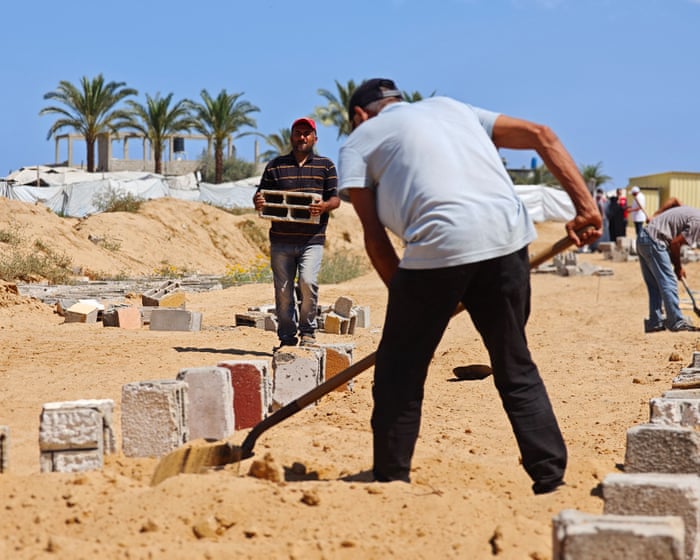
A cemetery established in Deir al-Balah now holds over 650 unidentified bodies, each grave numbered and documented in hopes of future identification. Ziad Obeid, director of Gaza's cemeteries department, noted that some bodies have been buried for over two years.
The situation is worsened by the lack of DNA testing equipment in Gaza's remaining hospitals. Israel does not allow such materials to enter. Genetic material also degrades over time, making identification progressively harder.
Beyond the technical challenges, the unidentified dead cause profound psychological trauma. Psychologists describe this as "ambiguous loss," leading to depression, trauma, and identity confusion among families.
Personal stories illustrate the anguish: Saed al-Yazji's brother Sameh disappeared on October 7, 2023, and his family lives in constant uncertainty. Wael Radwan lost his father and brother in December 2024, and their bodies were bulldozed at a hospital site; without death certificates, his brother's children cannot receive orphan assistance.
Israeli officials stated that there is no approval to bring body recovery equipment into Gaza. Griffiths reiterated the importance of allowing such equipment to uphold the right of families to know the fate of their loved ones.
