Saturn at its closest to Earth this year – how to spot it
Saturn reached opposition on 4 October and is now at its nearest point to Earth this year, making it easy to see with the naked eye through the night. The planet remains clearly visible for several evenings in a row.
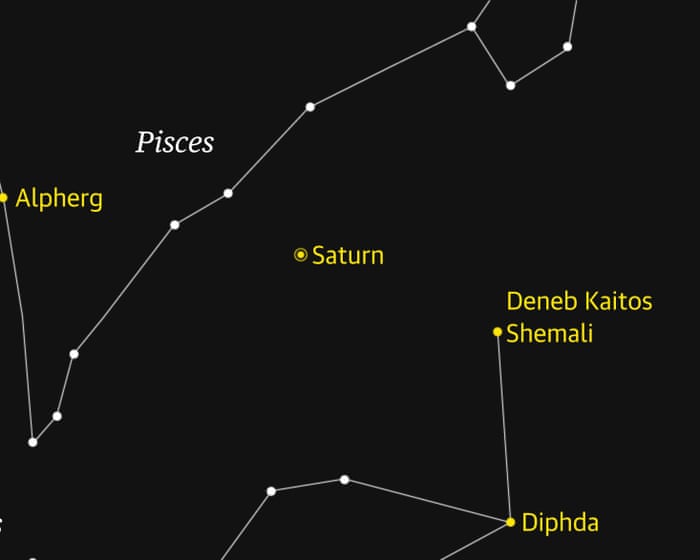
This week gives stargazers a good chance to track down Saturn, the giant planet that orbits roughly ten times further from the sun than Earth does. On 4 October, Saturn reached opposition, a configuration where Earth passes almost directly between the planet and the sun.
Because of this alignment, Saturn rises as the sun sets, stays visible all night, and sets around sunrise. This also places the planet at close to its nearest distance to Earth for the entire year.
Finding Saturn in the sky
Saturn is bright enough to see without any equipment, appearing as a moderately bright object with a creamy-white colour. Unlike stars, its light stays steady instead of twinkling. It currently shines at roughly magnitude +0.3.
From London at around 9pm local time on 5 October, Saturn was already well above the south-eastern horizon and continued rising higher as the evening went on. It can be located beneath the Great Square of Pegasus, a well-known star pattern that acts as a useful marker.
Observers are encouraged to check back on Saturn over several evenings, since unlike the fixed stars around it, the planet gradually shifts position against the background constellations. Spotting its famous rings, however, requires a small telescope, as they aren't visible to the naked eye.
For viewers in the southern hemisphere, Saturn appears even more favourably placed, climbing to a greater height in the sky.