Serbia's LGBTQ+ community faces 'epidemic of violence'
Violence against LGBTQ+ people in Serbia is on the rise, and activists say attacks often go uninvestigated, fostering impunity.
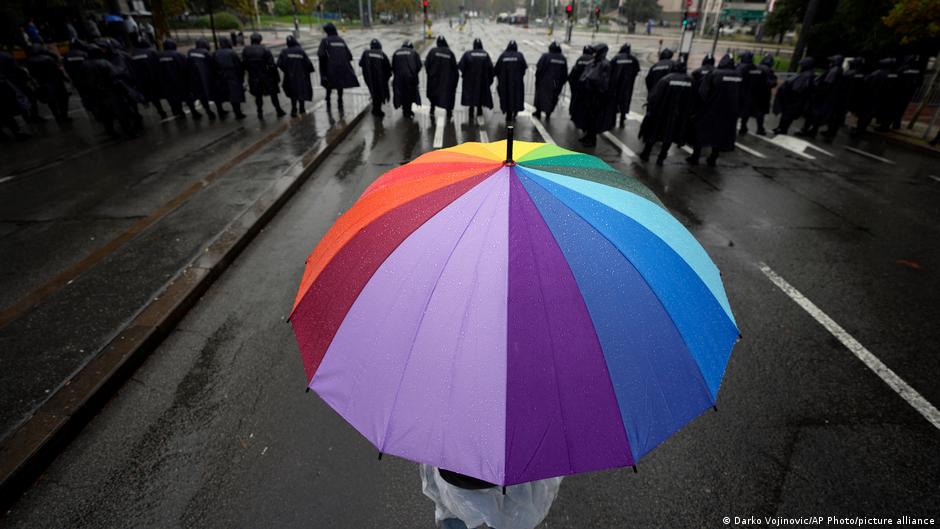
In Serbia, an EU candidate country, violence against people who deviate from the mainstream is becoming increasingly common. On July 11 in Belgrade, Aleksandar Savic, known as drag queen Alexis Plastik, was attacked on a bus. A woman stabbed him with a sharp object after homophobic insults, causing a cut to his calf and eye injuries. Just hours earlier, right-wing thugs attacked author and Krokodil Literary Festival program director Vladimir Arsenijevic in central Belgrade as he prepared for a memorial event for the 1995 Srebrenica genocide.
Plastik called the situation an "epidemic of violence" in an interview with broadcaster N1. The rising violence from groups linked to President Aleksandar Vucic and his Serbian Progressive Party (SNS) has reinforced the feeling that anyone who is different can become a target. Matija Stefanovic, program coordinator for the LGBTQ+ group Da se Zna! ("For Your Information!"), which documents violence against queer people in Serbia, said: "Violence is becoming increasingly normal, while protection against it is anything but guaranteed — especially for those who speak out against social or political problems, or who are unpopular with the general public."
Last year, Da se Zna! recorded 110 cases — more than ever before. This is partly due to increased awareness, but dramatic high-profile cases are also becoming more frequent. In mid-May, unknown attackers used tear gas on a queer bar in Belgrade. At the end of May, a trans woman and her partner were beaten unconscious. Many queer people in Serbia are afraid to openly show their identity. In a survey by the European Union Agency for Fundamental Rights, about 80% of respondents said they avoid holding hands with their partner in public.
The International Lesbian, Gay, Bisexual, Trans and Intersex Association's (ILGA) Rainbow Map shows Serbia has dropped to 29th place in Europe, six spots below the average. Five years ago, it was 22nd. The only solution to stigmatization and violence is education, says Stefanovic. Alongside the annual Pride parade, Da se Zna! organizes a Pride Caravan to small towns to send the message: we are here and we are not going away. In some towns, they are greeted by a handful of supporters with rainbow flags and dozens of protesters shouting homophobic slogans. After publishing the planned destinations this year, the group received several death threats. The event in Pirot was canceled in mid-July because police could not guarantee safety. Three journalists covering the event were attacked by the crowd.
Stefanovic himself grew up queer in a small town. He remembers praying to God to turn him into a boy. Only when he moved to Belgrade for his studies did he feel free to live openly as Matija. He underwent hormone treatment and filmed his transition, posting videos on YouTube and TikTok. Despite attracting attention from right-wing groups on Facebook, he decided to remain visible so that trans people would someday belong. His conservative father was the first to consistently use the correct pronoun and new name. Last year, both his parents joined the Belgrade Pride parade for the first time. "I'm so proud of them," said Stefanovic. "My parents have become my greatest allies."