At least 47 dead as rescuers search for survivors after powerful Indonesia earthquake
A magnitude 7.7 earthquake struck Indonesia's Flores island on Saturday, killing at least 47 people and severely damaging hundreds of buildings. Rescue teams are still searching for survivors as the full scale of destruction remains unclear.
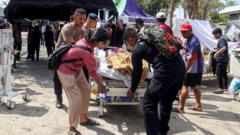
A powerful magnitude 7.7 earthquake hit Indonesia's Flores island early Saturday morning, shortly before 05:00 local time, at a depth of 15km, according to the country's meteorology and geophysics agency. Dozens of aftershocks followed, and rescue teams are continuing to search for survivors trapped under collapsed buildings. The confirmed death toll has reached at least 47.
Manggarai province was hit hardest, recording 24 deaths, while East Manggarai province reported 17 fatalities. Sikka province recorded three deaths, and at least one death each was reported in Ngada, Ende and West Manggarai provinces. At least two people were seriously injured and 11 sustained minor injuries. Tremors were reportedly felt as far west as Bima Regency and City.
Damage and relief efforts
Indonesia's National Disaster Management Agency (BNPB) said more than 10,500 aid packages have already reached operational bases in the affected region. However, assessing the full extent of the damage remains difficult given the area's remote, mountainous terrain. Early reports indicate more than 150 houses have been severely damaged, along with dozens of schools, several healthcare facilities, places of worship, offices and other public buildings.
Footage from the port in Maumere, Flores' largest town, showed large chunks of concrete falling from a terminal building onto passengers waiting to board an inter-island ferry. Several people were thrown into the sea after a ship's gangway collapsed.
East Nusa Tenggara governor Emanuel Melkiades Laka Lena said at a news conference that many victims were killed in their sleep when rubble collapsed on them. Others, like Arnold Welianto, a resident of the coastal village of Talibura in Sikka, East Nusa Tenggara, were jolted awake and rushed to check on their children. He told the BBC that many residents fled to the hills after noticing the sea had receded, a sign often associated with tsunami risk.
A separate magnitude 6.9 earthquake struck the other end of Indonesia around the same time, underscoring the country's vulnerability as part of the seismically active "Ring of Fire."