Stevedores expect economically sound decisions from new transport minister
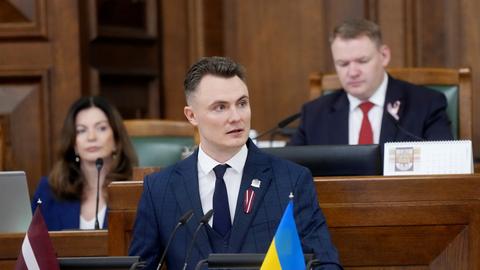
The Latvian Association of Stevedoring Companies expects the new transport minister, Krišs Lipšāns, to understand the sector's importance and base decisions on economic calculations. Lipšāns says his main task is to stabilise the areas overseen by the ministry.

The Latvian Association of Stevedoring Companies (LSA), which represents the cargo-handling firms of Latvia's major ports, said on 17 November that it expects the incoming transport minister, Krišs Lipšāns, to understand the role of transport and logistics in the national economy. Lipšāns was chosen for the post in the new Latvian government, formed by the Joint List and the National Alliance; the Saeima, Latvia's parliament, was expected to vote on approving the cabinet the same day.
The association stressed that it wants constructive cooperation with the minister, as LSA is the only representative of the interests of Latvia's large port stevedoring companies. It also expects decisions grounded in economic calculations that assess their effect on the sector's competitiveness and on the economy as a whole.
The minister's priorities
Lipšāns, previously the prime minister's adviser on legal matters, told the news agency LETA that his primary task will be to stabilise the situation in the areas overseen by the Ministry of Transport. He said there are very many problems and that a change of approach could prevent the situation from worsening further.
The minister named problems in public passenger transport, the airline airBaltic, the Rail Baltica railway project and the company Latvijas dzelzceļš (Latvian Railway). The latter will need a state budget subsidy of more than 30 million euros every year in the coming years.
Political context
The government will be led by Kulbergs. The Joint List won 41 seats in the parliamentary election and the National Alliance won 10. Together the coalition has a minimal majority of 51 votes. Ainārs Šlesers, whose party Latvia First has 17 deputies, has also promised support, although not all of them are expected to vote for the government. The Progressives, with 10 seats, and New Unity, with seven, remain in opposition.