Taiwan Develops AI-Guided Drone Swarms for Maritime Surveillance
Taiwan's Ocean Affairs Council is developing an AI system to coordinate drone swarms for continuous sea monitoring and to counter China's "gray zone" activities. A simulation of two 20-drone swarms flying at once has already been completed.
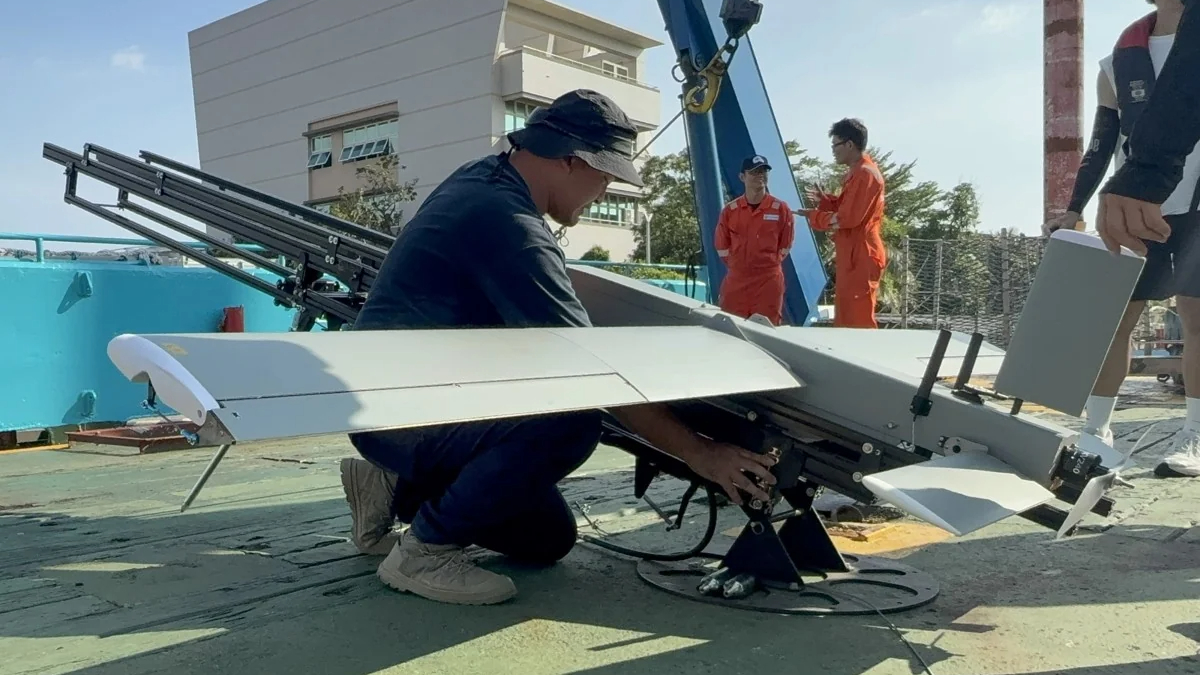
Taiwan is developing an artificial intelligence-based system to coordinate swarms of unmanned aerial vehicles (drones) and provide continuous maritime surveillance. The system is meant to help counter China's "gray zone" operations, meaning pressure that stays below the threshold of open armed conflict. The South China Morning Post reported this, citing a statement from Taiwan's Ocean Affairs Council (OAC).
Simulation and equipment
A research team led by National Cheng Kung University has already completed a simulation in which two swarms of 20 drones each flew simultaneously. The project marks a shift from controlling individual aircraft to autonomously coordinating entire groups.
The project relies on three US-made fixed-wing vertical take-off and landing (VTOL) aircraft: the JUMP 20, V-BAT and Flexrotor. Using AI and multi-agent reinforcement learning, the drones can distribute tasks among themselves, plan routes and hold formation. For flight safety, specialists integrated leader-follower collision-avoidance algorithms and a dynamic obstacle-avoidance system. The algorithms provide for spatial echeloning and keep at least 30 metres of vertical separation between drones.
Next steps
The OAC says the next stage will include hardware-in-the-loop simulation, prototype integration and flight tests over real sea areas to assess reliability in various maritime and weather conditions. The drone swarms are to serve as additional "eyes in the sky" for Taiwan's coast guard when it responds to various forms of Beijing's gray-zone provocations.
The programme is part of an OAC initiative to build an integrated "sea-air" coast guard that will combine unmanned platforms with upgraded intelligence, surveillance and reconnaissance (ISR) systems. The council noted that the wars in Ukraine and the Middle East have shown how drones are evolving from individually controlled platforms into coordinated swarms of different types.
Earlier steps
In July, Taiwan's Coast Guard Administration received 45 multirotor drones and began a large-scale basic training programme for operators. It later allocated 1.2 billion Taiwan dollars (US$39 million) to buy 12 V-BAT reconnaissance systems from the US company Shield AI, plus six control stations. On 7 October, the first delivered V-BAT was publicly demonstrated at the port of Taipei, attended by OAC minister Kuan Bi-ling and National Security Council Secretary-General Joseph Wu.