Tallinn to Show Works by Vivian Maier, the Photographer Discovered Only After Death
The Fotografiska center in Tallinn is opening a major exhibition of Vivian Maier, a nanny who secretly photographed street life throughout her life and is now regarded as one of the 20th century's greatest street photographers.
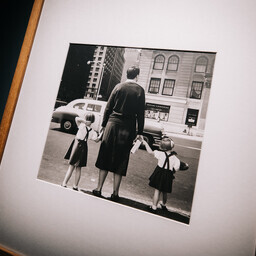
The Fotografiska art center in Tallinn is opening a large exhibition dedicated to American photographer Vivian Maier. She worked her entire career as a nanny for families in Chicago and New York, yet after her death she was revealed to be one of the most significant street photographers of the 20th century.
In 2009, US collector John Maloof bought a box of old negatives at auction for a small sum; the negatives had been put up for sale over unpaid storage fees. After looking through a few of them, he was struck by the striking images of city life. Searching further, he found a storage unit holding the rest of the archive — around 150,000 negatives, roughly 3,000 prints, along with film reels and audio recordings of street interviews.
Through his own research, Maloof identified the author of the photographs as Vivian Maier — a solitary woman who worked as an ordinary nanny but photographed obsessively her whole life without ever showing her work to anyone. According to exhibition curator Anne Morin, photography was Maier's own private space of freedom, and there is no evidence she ever tried to sell her images to magazines.
Maier had neither family nor close friends, but she photographed everything around her with near obsession: the children in her care, people on the streets and in parks, and details of urban life. Fotografiska Tallinn curator Marja Loorents noted that Maier herself was something of an "invisible" person, which gave her a talent for noticing overlooked people whom others usually pass by without a glance.
Influence of two cultures
The curator emphasized that Maier's work goes far beyond simple street photography, carrying humanism, empathy and occasional humor, with a visual language comparable to the greatest photographers of the 20th century. She had a broad cultural life, regularly attending cinema, theater and exhibitions. Loorents said her work reflects a duality between the contemplative French humanist tradition of Robert Doisneau and Henri Cartier-Bresson and the more aggressive style of American street photography, and that Maier deserves to be ranked alongside figures such as Diane Arbus and Henri Cartier-Bresson.