Tallinn's Taru complex prepares to open, housing state agencies and the Natural History Museum
A museum and office complex called Taru has been completed next to the Noblessner quarter in Tallinn, Estonia. Several state bodies will move in, with the first staff of the Land and Spatial Board arriving on 9 November.
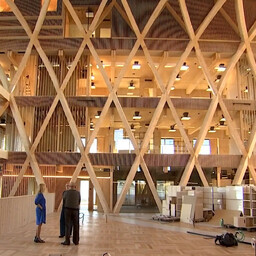
A museum and administrative complex named Taru, meaning "beehive", has been completed in Tallinn next to the Noblessner quarter. Several Estonian state agencies and research institutions will move in, and the plan's initiators say the arrangement will bring some savings for the state.
The three connected buildings have a combined area of about 24,000 square metres. Roughly a third is allotted to the Natural History Museum, while the rest will be offices of government bodies. The complex has room for about 570 employees, and its modern open-plan layout would allow up to 700 if needed.
Who is moving in
One building will house the Land and Spatial Board, the Institute of the Estonian Language and the Language Board, along with the museum entrance and space for large events. The other will host the Environmental Board, the Environment Agency and the Environmental Investment Centre. Taru director Riina Roosipuu told the ERR programme "Aktuaalne kaamera" that space for about a hundred more employees remains free, and talks with interested agencies are under way.
The first to move, on 9 November, will be 108 staff of the Land and Spatial Board's Tallinn office, relocating from Mustamäe. Director General Kati Tamtik said the current building dates from the early 1980s and is outdated. The board now occupies four floors, but thanks to efficient workplace planning will need only one and a half in Taru.
Arvi Tavast, director of the Institute of the Estonian Language, said the Ministry of Education and Research lacks the money to renovate the whole building on Roosikrantsi Street, so the institute chose to relocate.
Cost and technology
Construction cost 54 million euros excluding turnover tax, mostly funded from European Union sources. The building is made largely of wood and uses recycled construction materials, solar panels, a seawater-based cooling system and a bioreactor for processing bio-waste. Roosipuu said she hopes the building and its operation will serve as an example of sensible use of natural resources.