Holmi Quarter Planning in Tartu Delayed by Archaeological Surveys
In the Estonian city of Tartu, preliminary archaeological surveys must precede the Holmi quarter's detailed plan, pushing its completion to 2027. The area is intended for new buildings with public recreation zones.
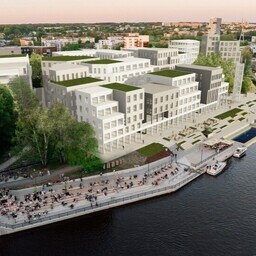
Preliminary archaeological surveys are set to begin soon in the planned Holmi quarter in central Tartu, Estonia's second-largest city. This is one reason the detailed plan being prepared for the area will need adjustments, and its completion has been pushed to next year.
The Holmi quarter covers roughly three hectares on and around the site of the former Atlantis nightclub. The landowners include the state, the local government and private individuals. Tartu started drawing up the detailed plan two years ago to explore building new structures with public recreation areas there.
Building heights and greenery
City architect Irži Tintera said buildings will generally be up to six storeys, while at the corner where Narva Road meets the Võidu bridge, structures of up to eight storeys will be allowed. A draft of the main plan drawing was prepared last summer, based on the design that won an architectural competition. Stakeholders have met repeatedly to discuss it, and the city recently sent the planner several proposals for changes.
Greenery prompted the liveliest debate. The lime tree avenue on Raatuse Street will be kept in full, although the original version called for replacing it. On Narva Road, the existing avenue will be replaced with new trees, since the city wants buildings to stand closer to the road and form an enclosed street space.
Underground parking
No final decision has been made on the planned underground parking either. The planner has been asked to provide for up to two underground levels and, in some places, to link their underground parts. Tintera said more amendments are likely, as an access road to the parking is still being sought, which will significantly affect the development.
Archaeological surveys
The area contains an archaeological cultural layer typical of the medieval and early modern periods in Tartu's suburbs, and current requirements call for mapping the heritage that survives there. The preliminary work includes up to four trial boreholes, so that buildings are not designed over valuable layers. If construction goes ahead, full archaeological research will be required. Results will be ready by spring 2027, so the final version of the detailed plan is expected in mid-2027.