UK set for near-total solar eclipse this Wednesday evening
People across the UK will see their best solar eclipse since 1999 on Wednesday evening, with the moon covering up to 95% of the sun in some areas — the last such chance until 2081.
On Wednesday evening, people across the UK and Ireland will witness an almost total solar eclipse for the first time since 1999, with the next comparable opportunity not coming until 2081. An eclipse happens when the moon passes between the sun and Earth, blocking sunlight partially or fully.
Across the UK and Ireland, the moon will cover between 90% and 96% of the sun. North-western Europe will see roughly 88-95% coverage, while parts of Greenland, Iceland and northern Spain will experience a total eclipse lasting up to two minutes and 18 seconds.
Within the UK, coverage varies by location, with the west seeing the most: 95% in Plymouth, 93.2% in Cardiff and 93.1% in Belfast. Manchester will see 91.9%, London 91.4%, Edinburgh 90.7% and Newcastle 90.2%, while Shetland will have the lowest coverage at 88%.
Where and when to watch
Royal Observatory Greenwich astronomer Jess Lee recommends finding elevated spots with a clear view to the west, such as Parliament Hill, Alexandra Palace or Primrose Hill in London. The eclipse begins around 6.08pm in Edinburgh and Glasgow, 6.10pm in Belfast, 6.13pm in Manchester and Liverpool, 6.15pm in Birmingham, 6.17pm in London and 6.18pm in Cornwall, with maximum eclipse roughly an hour later and the event ending around 8pm.
Forecasters say August gives a better chance of clear skies, though Scotland and Northern Ireland currently face a higher risk of cloud and rain, with clearer conditions more likely in the south and east.
Safety first
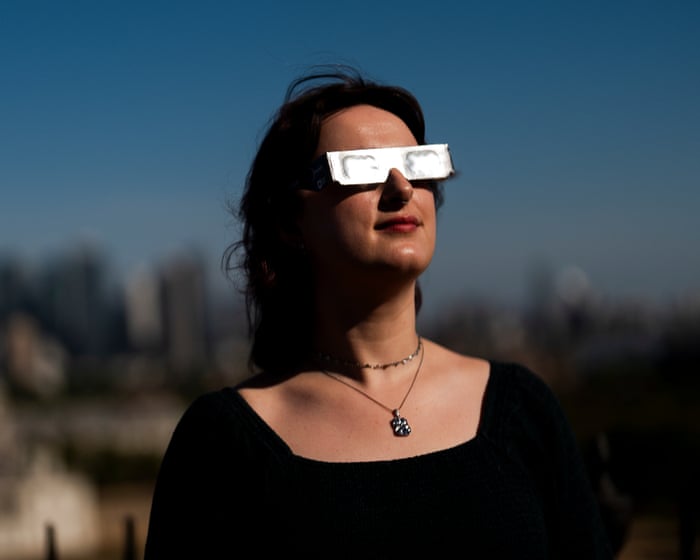
Experts stress that eclipse glasses meeting the ISO 12312-2:2015(E) safety standard, or indirect viewing methods such as pinhole projection, are essential, since staring directly at the sun can damage the retina without pain. About 70 people reported vision problems after the 1999 eclipse. University of Manchester astronomer Sarah Crowther noted that animals may fall quiet during the eclipse, mistaking it for nightfall.