Trump's nuclear deal with Saudi Arabia reverses long-standing US policy
President Donald Trump has signed a nuclear agreement with Saudi Arabia, dropping the requirement that Riyadh normalize relations with Israel, sparking concerns about a nuclear arms race in the Middle East.
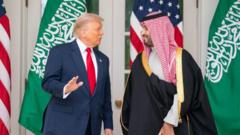
The Trump administration's nuclear deal with Saudi Arabia marks a significant shift from decades of US policy, which had conditioned the transfer of American nuclear technology for civilian energy on Riyadh normalizing ties with Israel. President Donald Trump granted Saudi Arabia its desired nuclear cooperation without extracting any concessions regarding Israel, despite objections from critics who warned it could trigger a regional nuclear arms race. The agreement is the latest example of Trump abandoning the traditional US approach to the Middle East, which prioritized Israel and a two-state solution to the Israeli-Palestinian conflict. In his second term, Trump has focused on bolstering US economic influence to compete with China and other rivals. Analysts say the nuclear pact signals Washington's desire to keep regional allies close, even at the expense of angering Israel. "Countries in the Middle East want to develop their nuclear infrastructure and they're going to do it even if the US is not involved. Washington at this point is recognizing that," said Yusuf Can, a Middle East expert. Details of the deal were not immediately released, but it reportedly lacks strict enforcement measures to prevent Saudi Arabia from developing a military nuclear program in the future. It differs from a 2009 US-UAE nuclear cooperation agreement that included rigorous IAEA inspections. Additionally, Saudi Arabia is reportedly allowed to enrich uranium on its own soil. Even if Riyadh does not immediately pursue nuclear weapons, the potential ability to do so could provide a powerful deterrent, analysts said. "It certainly helps lay the groundwork for nuclear weapons in the future," said Imran Bayoumi, a former US Defense Department policy adviser. The deal allows Saudi Arabia to diversify its energy sector and meet rising electricity demand, potentially reducing its reliance on oil, said energy expert Christopher Russo. Saudi Arabia secured the agreement without recognizing Israel or dropping its demand that any normalization with Israel be tied to the creation of a Palestinian state. This concession reflects the Trump administration's calculation that a diplomatic breakthrough between Saudi Arabia and Israel is unlikely soon, as talks stalled after the Israel-Hamas conflict in Gaza and the US-Israel war with Iran. The deal has already drawn criticism in Israel and the US. Some Israeli politicians warned Saudi Arabia could become a new nuclear threat. "A civilian nuclear program in Saudi Arabia [will] lead to a mad arms race across the entire Middle East," former defense minister Avigdor Lieberman said on social media. Democratic Congressman Ro Khanna called the deal a "giveaway to the Saudis" that would fuel Iranian ambitions and destabilize the region. US Energy Secretary Chris Wright said the agreement would boost the economy and strengthen national security, upholding high nuclear safety and nonproliferation standards. However, skepticism was fueled by Trump's absence from the signing ceremony; he attended a dignified transfer for four US service members killed in Iran, then held a rally in Georgia.


