Unusually Regular Rows of Boulders Found on Mars Remain Unexplained by Scientists
The HiRISE camera on NASA's Mars orbiter has captured long, curved rows of boulders on the Daedalia Planitia highlands that resemble a fingerprint. Scientists are unsure how the terrain formed and have put forward several hypotheses.
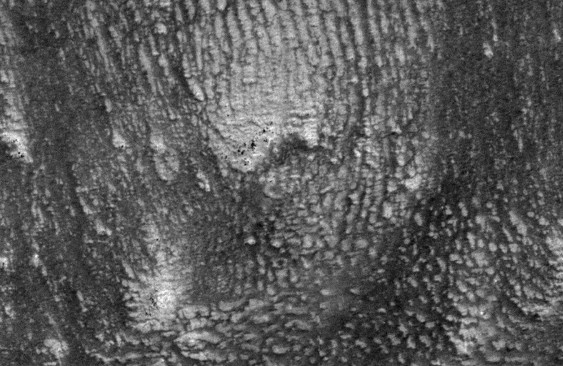
The HiRISE camera aboard NASA's Mars Reconnaissance Orbiter has captured images of unusually regular rows of boulders on Mars, in the Daedalia Planitia highlands. The area lies in the Tharsis volcanic region near the planet's equator. Scientists cannot yet explain how these formations came about, according to the science outlet ScienceAlert.
From smooth terrain to a complex pattern
Images taken from orbit in 2002 showed a relatively flat area with practically no relief. But new pictures taken with HiRISE in August 2024 revealed a different view. Zooming in on a surface area of roughly 5 by 15 kilometres shows an intricate system of gracefully curved lines.
Paul Geissler, a planetary scientist at the U.S. Geological Survey, wrote in October 2024 that light-coloured boulders are arranged in long, curved rows, 5 to 10 metres apart, and that the resulting pattern resembles a fingerprint. He noted that similar patterns have not been seen anywhere else on Mars and that scientists are not sure how this terrain formed.
Possible explanations
Rocks gathering in a set pattern is not unheard of in itself. On Earth there is a phenomenon known as sorted patterned ground, which can produce remarkably regular stripes, circles and polygons. It is especially common in cold regions, where repeated freeze-thaw cycles gradually separate larger rocks from smaller soil particles. The Daedalia Planitia highlands, at an elevation of 5,455 metres, may have their own freeze-thaw cycles, but this cannot be confirmed.
Another hypothesis involves seismic vibrations, which are known to shake the Red Planet. They could cause the so-called Brazil nut effect: if nuts of different sizes are placed in a container and shaken vigorously, the larger ones rise to the top while the smaller ones sink. A similar sorting could happen to boulders when the ground beneath them trembles.
The article concludes that although the rocks are ordinary minerals, they keep surprising scientists and creating new mysteries.