Gold-plated skull sculpture honouring Lithuanian royal romance sparks debate
A newly unveiled sculpture in Vilnius commemorating Grand Duke Sigismund Augustus and Barbara Radziwiłł has drawn both praise and sharp criticism over its use of gilded skulls.
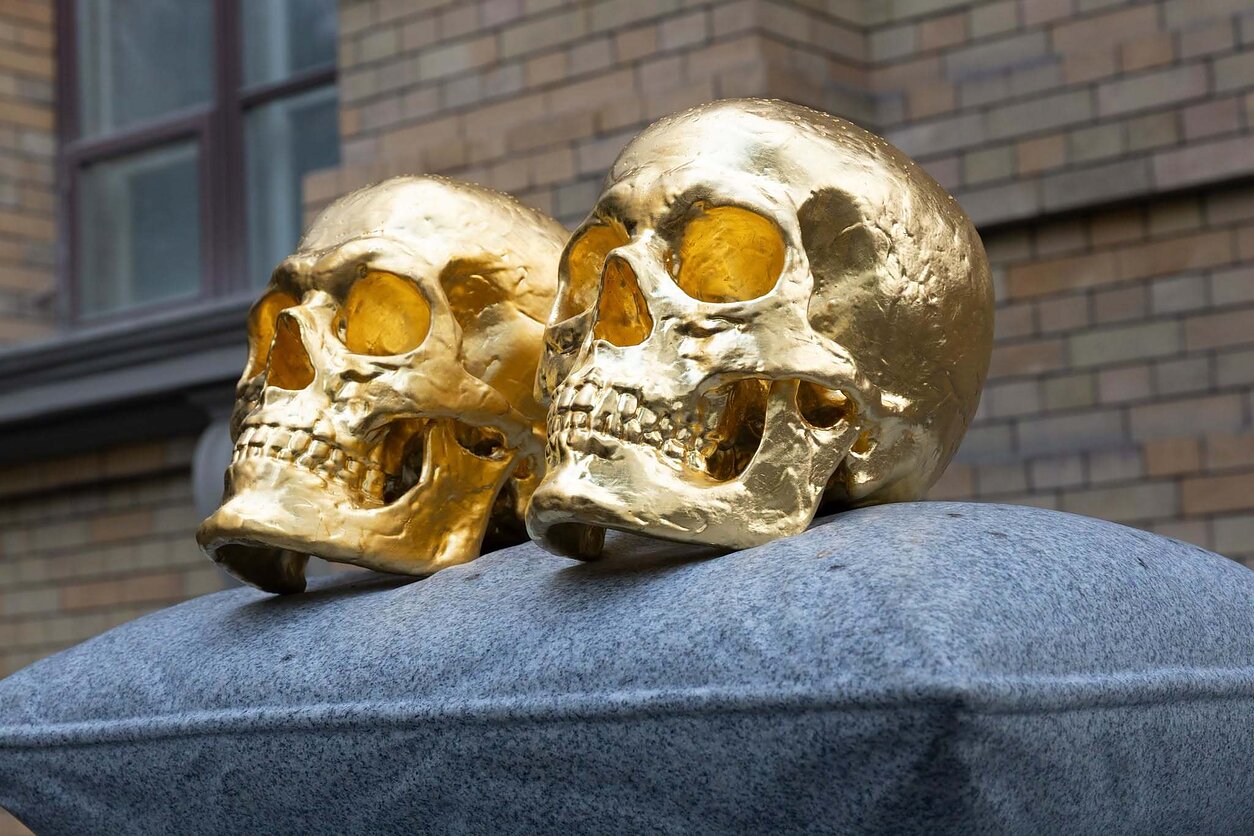
A new sculpture honouring one of Lithuania's most celebrated love stories has been unveiled in the courtyard of the Vrublevskių Library of the Lithuanian Academy of Sciences in Vilnius, prompting mixed reactions. Titled "Žygimantas ir Barbora," the piece portrays two gold-plated skulls resting side by side on a pillow, representing Grand Duke Sigismund Augustus and his wife Barbara Radziwiłł.
The design was chosen through a 2024 competition that drew more than 20 entries, reviewed by two panels — one made up of five library staff members and another of seven sculptors, artists and art specialists. The winning proposal came from sculptor Gediminas Piekuras, working with architect Aušra Gvildienė. According to the library, the work was conceived as a two-towered cathedral encapsulating the enduring appeal of the sixteenth-century story, including the couple's extraordinary love and the memory of Vilnius' golden age.
Funded entirely by private sponsors at a cost of 60,000 euros, the project was initiated by the library community itself. The chosen location carries historical weight: the Radziwiłł Palace once stood on the site, and it was there that Barbara Radziwiłł was raised alongside her siblings in the household of military commander Jerzy Radziwiłł and Barbara Kolanka.
Kamilė Gogelienė, who chairs the Vilnius municipal Historical Memory Commission, praised the sculpture at its unveiling, calling it a remarkable tribute to one of the Grand Duchy's most famous couples and their love story.
Criticism, however, quickly followed on social media. The State Cultural Reserve of Vilnius Castles described the piece as evoking "love beyond the grave." Historian Aivas Ragauskas was among the most vocal critics, questioning whether the sculpture would endure for decades and calling the skull motif an overly conventional depiction of death that fails to capture the exceptional nature of the romance. He argued that without the gilding, the work would amount to little more than "two simple skulls," and that the gold plating alone does not meaningfully connect the piece to the couple's story. Sigismund Augustus and Barbara Radziwiłł secretly married around 1547, a union that stirred controversy among the Polish nobility.