North Korea appears to hold back on sending Russia more troops
Contrary to predictions made by Ukraine's president over the summer, a large new North Korean troop deployment to Russia has not materialized. Analysts say Pyongyang is limiting its involvement in the war while continuing to supply Moscow with ammunition and weapons.
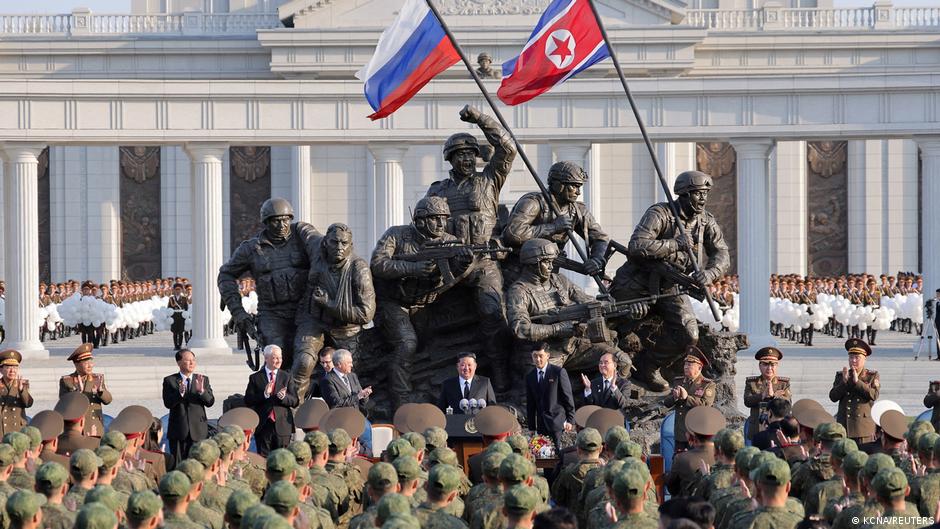
Ukrainian President Volodymyr Zelenskyy suggested over the summer that 30,000 to 50,000 North Korean soldiers could be sent to Russia to support its war against Ukraine. That buildup has not materialized so far, and it is unclear whether Pyongyang will keep sending large numbers of troops.
Andrii Kovalenko, who stepped down in September as head of Ukraine's Center for Countering Disinformation, pointed on Telegram on November 9 to an August intelligence assessment. It said the Kremlin had asked for more than 30,000 additional North Korean troops for an autumn offensive. A summit expected in September between North Korean leader Kim Jong Un and Russian President Vladimir Putin did not take place. North Korea had already sent thousands of troops in 2024 to Russia's Kursk region, where Moscow was repelling a Ukrainian incursion.
Kovalenko believes Pyongyang rejected the request because taking part in offensive operations in Russian-occupied parts of Ukraine's Donetsk region may still be a red line for North Korea. He stressed, however, that Russia still relies on North Korean material support, especially ammunition, and that another major deployment of combat troops this winter looked unlikely. He also said North Korea keeps a missile unit in Russia's Voronezh region and about 8,500 support personnel in rear areas, including drone operators, engineers and sappers.
Experts: winter and costs reduce the need
Han Ki-bum, a former deputy director of South Korea's National Intelligence Service, told DW that the lull in fighting and the onset of winter give Pyongyang little immediate reason to send reinforcements. In his view, a visit to Moscow this week by Jo Yong-won, a senior North Korean official, could shed light on future plans. Ahn Chan-il, head of the World Institute for North Korea Studies in Seoul, said Moscow will also weigh battlefield needs against the cost of bringing in more troops.
Balancing Russia and China
Kovalenko describes Pyongyang's approach as a "containment strategy": limiting its military commitment while keeping ties with both Moscow and Beijing. On November 17, Zelenskyy said Russia was receiving dozens of North Korean ballistic missiles each month, and that their use in Ukraine helps Pyongyang refine its weapons. Experts expect military cooperation with Russia to continue, while Pyongyang also seeks support from China.