Second complete fruit fly brain map finished, revealing sex-based neural differences
Scientists at Janelia Research Campus and Google have completed a full connectome of a male fruit fly's brain, complementing an earlier map of a female brain and shedding light on sex-specific neural wiring.
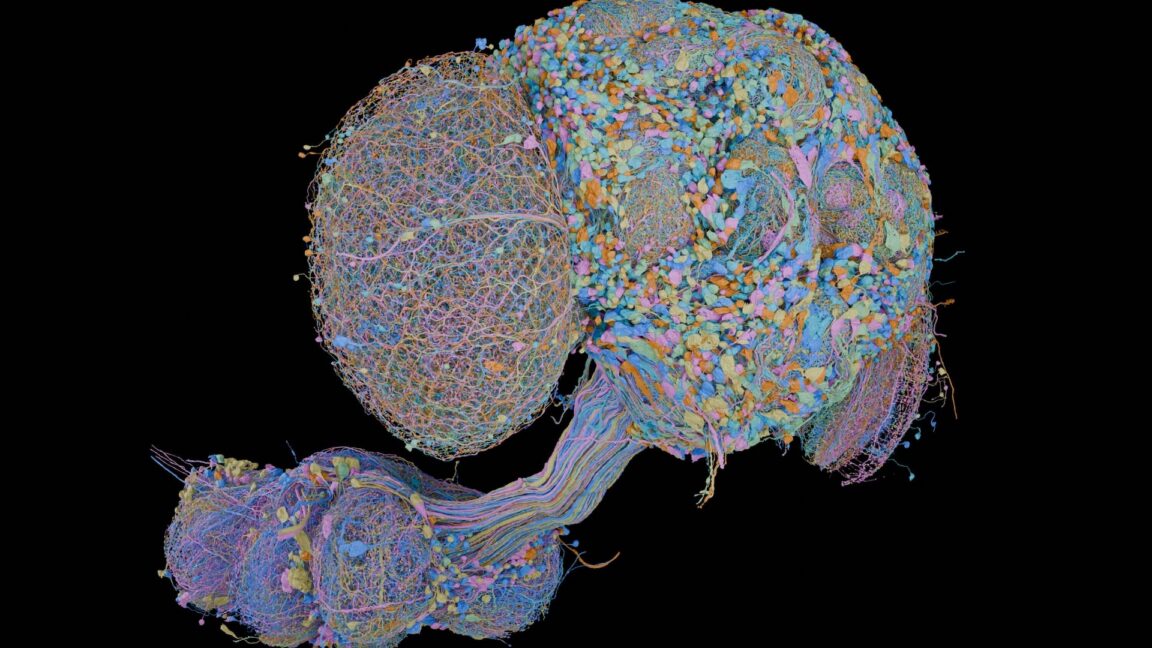
Researchers at the Howard Hughes Medical Institute's Janelia Research Campus, working with computer scientists at Google, have completed a full map of every neuron and connection in a male fruit fly's brain — known as a connectome. This is the second such achievement, following the completion of a female Drosophila connectome earlier this year.
While the fruit fly's nervous system contains roughly 150,000 neurons, the new work uncovered more than 300 million synaptic connections within the brain alone. To build the map, researchers sliced a dissected brain into a large series of evenly spaced sections and imaged them using electron microscopy. AI models then reassembled the slices digitally, traced individual cells through three-dimensional space, and identified and classified synapses. Human proofreaders provided feedback to fine-tune the sensitivity of these models. The entire process, from an intact brain to a finished connectome, took about four years and involved a team of around 50 people.
Comparing male and female brains
By comparing the male and female connectomes, researchers found 289 neurons unique to males, 71 unique to females, and 138 present in both sexes but differing in shape and connections. Most of these differences relate to activity of the genes doublesex and fruitless, which are known to drive sex-specific behavior, though the link was not always direct.
The team also found that sex-specific neurons tend to operate away from basic sensory input or motor control, instead functioning within higher-level processing and decision-making circuits.
Researchers expect the connectomes will accelerate neurobiology research by letting scientists quickly trace how any given neuron connects to broader brain structures. The techniques developed for this project are also expected to support future mapping of more complex nervous systems, potentially including those of vertebrates.

